











Evolving standards for sizing collective positive-pressure flues

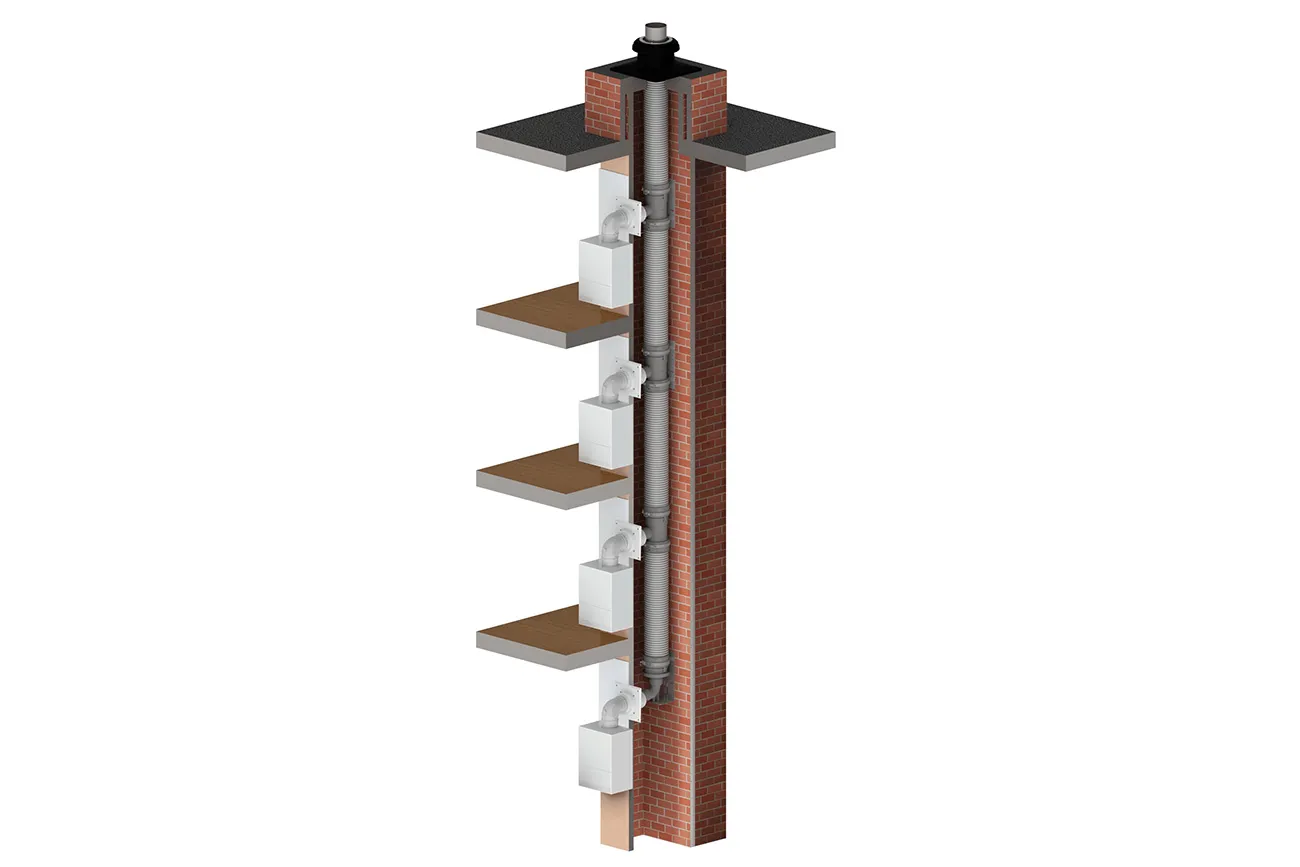
In a comprehensive technical note, flue specialist Poujoulat explains the new rules for designing collective positive-pressure flues. Collective positive-pressure systems have revolutionised flue gas discharge, offering significant space savings, among other benefits.
Collective positive-pressure flues were first used in Belgium around 2011. This marked a major development, and a revolution in the established C4 and C8 collective flue systems. Conventional collective C4 systems (known as CLV, 3-CE or LAS) and C8 systems (known as semi-CLV) used a flue duct operating under negative pressure to discharge combustion products. This is better known as natural-draught CLV.
Advanced CLV systems, by contrast, use a flue duct that discharges combustion gases under positive pressure.
Significant space savings
To regulate these new practices, CERGA drew up a technical dossier in June 2012, with the help of gas appliance manufacturers and metal and plastic flue manufacturers. The dossier made it possible to use condensing boilers in renovation projects. The standards and rules in force at the time made this technology available, bringing significant space savings straight away.
These new systems soon demonstrated their value and advantages over conventional solutions. Gradually, they replaced the “solutions of yesterday”, based on natural-draught CLV systems.
It should also be noted that since September 2020, an update to Kesa Aladin, the most widely used calculation software, has added a new rule to the calculation report. This rule is intended to automatically check what EN 13384-2 has required for several years: assessing the impact of “one boiler operating at part load while all the other boilers are at full load”.
This automatic software parameter results in different, larger flue diameters compared with the previous calculation method and software. Previously, the “back pressure at full load” parameter was checked manually to meet the requirements of EN 13384-2, ensuring that the flue gases from a boiler at part load could still escape when the other boilers were operating at full load.
Practical implications
After simulating hundreds of configurations using products from various boiler manufacturers, whose products account for around 90 per cent of the boilers installed on collective flues in Belgium, Poujoulat identifies the following general implications for designing shared flues for positive-pressure boilers.
- Overall, the maximum number of boilers that can be connected to a single flue is lower than under the previous calculation method.
- In general, the calculated diameters are larger than with the previous sizing method.
- In some cases, both effects can occur together: fewer boilers and larger CLV diameters.
In most cases, familiar or experience-based “old” sizing methods must be abandoned and checked against an updated calculation report. Since these calculations generally require specialist software, it is important to check that the report itself is up to date and incorporates the changes to the standard.
The full technical dossier, ‘Sizing collective positive-pressure flues in accordance with current European regulations’, can be downloaded from the Poujoulat website.
Question about this story? Ask your question
Keep following this
Get an email when a new story is published. No account needed.
- SubjectNews







