











EnergyVille expert talk tackles the challenge of heating
Under the title ‘Expert talk: from fossil fuels to green heat’, research institute EnergyVille (a research collaboration between KU Leuven, VITO, imec…
‘Local authorities play an important role in decarbonisation’
Last year, research institute EnergyVille (a research collaboration between KU Leuven, VITO, imec and UHasselt) published a highly engaging paper entitled ‘Expert talk: from fossil fuels to green heat’. It can serve as a reference for anyone wanting to learn more about what is perhaps the heating sector’s greatest challenge. Installatie & Bouw spoke to the text’s three authors: Nele Renders, Ann Wouters and Pieter Vingerhoets (EnergyVille/VITO).
I&B: In your view, is the problem of slow decarbonisation a technical issue, or do various external factors play a more decisive role?
EnergyVille: “From a technical point of view, almost every problem can now be solved. The solutions may not all be equally efficient, but various factors are at play, and these are often non-technical in nature. A few examples:
The heating sector comprises many small players at local and national level.
Given the range of different needs, the sector depends on a wide range of technologies, infrastructure and energy sources.
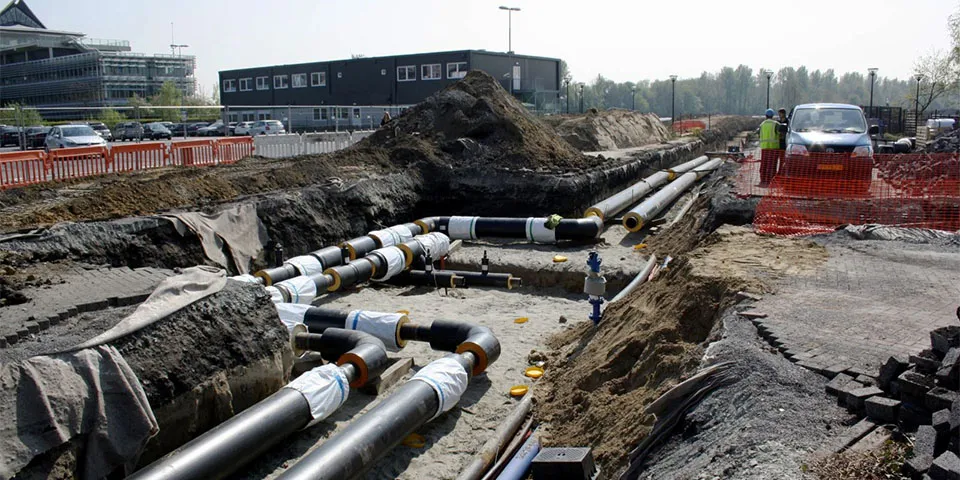
The variation in needs is also a result of differing climatic and geographical conditions. Building density also determines the choice of technology. Densely built-up areas, for example, are better suited to a collective solution such as district heating networks, unlike rural areas.
‘From a technical point of view, almost every problem can now be solved.’
Furthermore, the demand for heat is primarily local, unlike electricity, which can be transported efficiently over long distances. This means that heating capacity must be installed relatively close to where it is used.
Because of the strong dependence on local contexts, the wide variety of technological solutions and the fragmented structure of the sector, the decarbonisation process poses a major challenge for society and, therefore, for the heating sector in particular. Limited access to investment capital is an additional factor slowing progress.”
I&B: A frequently cited argument against green heat, generated by heat pumps, for example, is that it is affordable and feasible. Is fully electrifying heating a pipe dream?
EnergyVille: “Depending on the location, local renewable energy potential, urban density and the condition of buildings, the best option will be a shift to ‘stand-alone all-electric’ heating or district heating. Heat pumps will play an important role in low-carbon heating. They are energy-efficient because they rely on electricity for only part of their energy needs, using free ambient heat for the rest.
High upfront costs and long payback periods for renovation are major barriers to action in general. This calls for new financing models. In any case, the pace of renovation will have to increase to meet European targets. We need to go from 0.8 per cent today to 3 per cent by 2050. Industrialising the renovation process is essential for innovation. This must not only accelerate renovation, but also improve the quality and cost-effectiveness of deep renovation in homes and neighbourhoods.
Renovation can be carried out in stages, based on a roadmap for the building, neighbourhood or city. In this way, investment can coincide with natural intervention points, such as the sale of a building, essential repairs or general renovation, or major infrastructure works such as sewer replacement.
I&B: In the Expert Talk, you see local authorities as having an important role to play. Do you think local authorities are sufficiently interested in driving the transition in practice?
EnergyVille: “We find that local authorities are often strongly committed to creating carbon-free municipalities, but lack the expertise and budgetary scope needed to take decisive action. A project such as building a district heating network is complex not only technically, but also socially.
At EnergyVille, we provide technical support to municipalities through models that help make heating demand more sustainable. Local authorities play an important role in this. First, they often have the best knowledge of the local situation and access to relevant data sources. Second, they are also an essential point of contact for residents. Third, they need to develop a vision of which solutions are best suited to which areas, through so-called ‘heat zoning plans’.

‘The decarbonisation process poses a major challenge for the heating sector.’
This role not only raises the profile of local authorities among residents, but also enables them to generate benefits for their communities. If, for example, a CO2 levy on fossil fuels were introduced, a municipality could ensure that its residents did not bear the cost by facilitating a district heating network powered by fossil-free sources.”
I&B: Are current policy plans enough to bring about sufficient change?
EnergyVille: “Studies show that a uniform, one-size-fits-all approach to the entire building stock is not desirable from a techno-economic perspective. Policy plans must therefore take local contexts into account to a great extent. For example: which heating solutions are possible, and where? What about waste heat, and where are there potential heat sources that could be used? Local authorities will play an important role in developing such plans, with support from technical partners.
Authorities are often still faced with ambiguities or uncertainties. Take district heating networks, for example: under what circumstances can a municipality approve an application? What vision for the future should underpin it? Who is responsible for building the network and ensuring a continuous supply of heat?”
The full expert talk is available at www.energyville.be.
Question about this story? Ask your question
Keep following this
Get an email when a new story is published. No account needed.
- SubjectNews







