Installatie & Bouw Vlaanderen is part of Louwers Mediagroep: 45+ trade platforms in the Netherlands, Flanders and Wallonia. Trade magazines, websites, newsletters, video and podcasts, since 1987.
CHP plays an essential role in Europe’s long-term strategy for 2050
COGEN Vlaanderen, the sector organisation for combined heat and power (CHP), held its study day ‘Flemish industry and the energy transition’ at the Brabanthal in Leuven on 5 December. The central question was: what challenges does Flemish industry face as it transitions to a sustainable, reliable and affordable energy system, in the context of European energy policy for 2050, and what role can CHP play?
Combined heat and power (CHP) achieves primary energy savings by producing electricity and heat simultaneously, regardless of the fuel used. Its major advantage is that it makes more efficient use of the energy contained in the fuel, thereby reducing CO2 emissions.
Growing interest and applications
CHP has been used for decades in certain sectors, including greenhouse horticulture, industry and healthcare. Driven by European targets, the technology has also become increasingly popular in recent years among SMEs and in the residential sector.
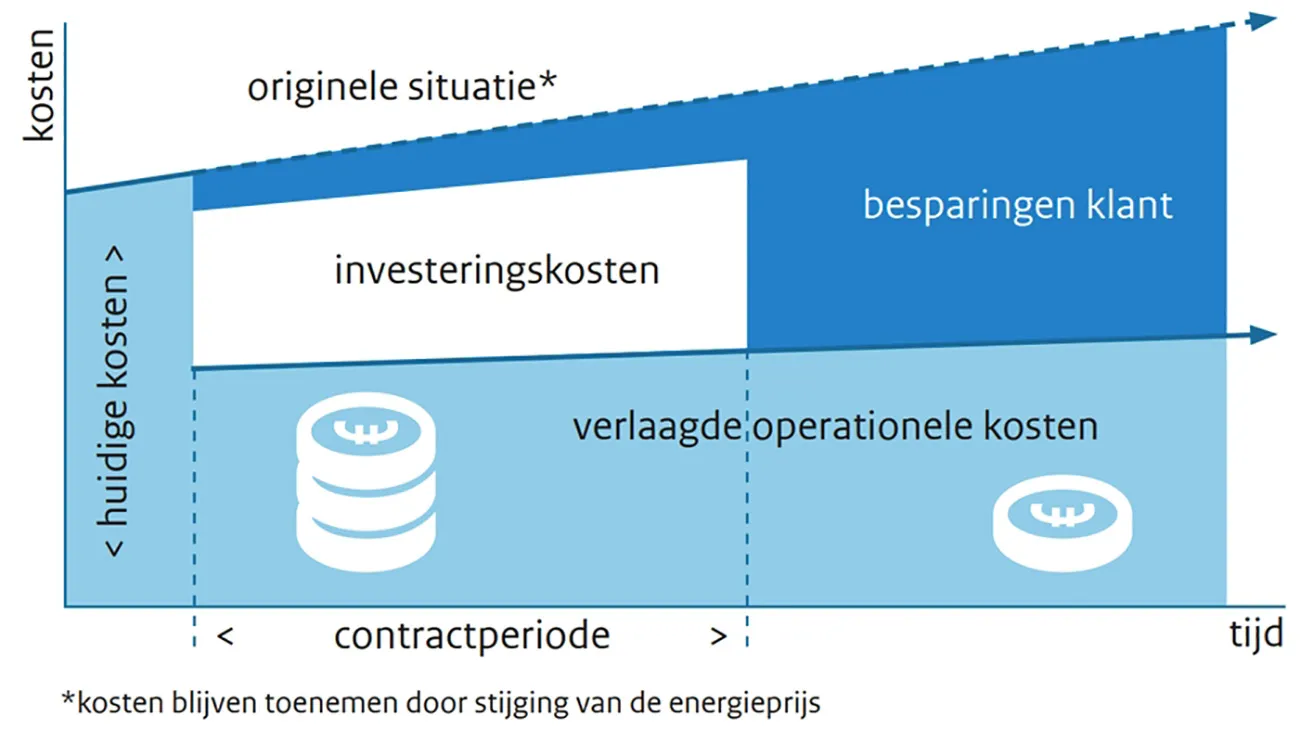
With the introduction of concepts such as energy sharing and local energy communities, CHP will increasingly find its way into apartment buildings and other forms of collective housing. CHP systems are also often included in so-called energy performance contracts (EPCs), under which a building’s management and maintenance are outsourced to a third party, often an Energy Service Company (ESCO). Growing interest in CHP, together with its wider geographical spread, is contributing to a network of numerous smaller, decentralised production units. This improves security of supply and limits losses in the electricity grid.
Het basisschema van een ESCO.
A system solution for Belgium’s energy needs
According to COGEN, CHP is a system solution. It contributes to reliable, flexible electricity generation that saves fuel and reduces emissions, while also enabling the further development of renewable energy and the decarbonisation of heat production.
In Belgium, installed electrical CHP capacity stands at around 2,700 MW, roughly the same as the capacity of Doel’s four nuclear reactors. There is also potential for a further 1,000 MW to be brought online by 2030. COGEN believes CHP must therefore be taken into account when considering security of supply. When the nuclear power stations close, more efficient CHP plants, as well as conventional gas-fired power stations, can provide an alternative.
The non-profit organisation also notes that CHP plants are being operated with increasing flexibility. A CHP plant no longer needs to run continuously. In horticulture, among other sectors, CHP plants are often installed in combination with thermal storage tanks.
Alongside flexibility, synchronisation is another key advantage of CHP, according to the sector organisation. Demand for heat and electricity often coincide. As heat production is further electrified through heat pumps, electricity demand will rise further at times when there is a demand for heat and CHP plants are running at full capacity. If heat pumps and CHP plants are distributed evenly at neighbourhood level, CHP plants can generate electricity locally and efficiently for the heat pumps during these periods.
What role can CHP play in the energy transition?
A warm challenge
Until recently, the energy debate focused mainly on green electricity. Yet heat accounts for 50% of primary energy consumption, twice as much as electricity.
As long as heat is not decarbonised, it will be impossible to meet sustainability targets. The message is clear: Europe aims to be carbon neutral by 2050, making heat networks indispensable in a climate-neutral landscape.
COGEN also sees an important role for CHP here. CHP can serve as a heat source for a heat network, as well as enabling its expansion. For example, using several CHP units makes it possible to build a heat network gradually. CHP can also help to recover waste heat from industry. While a heat network is being developed, a CHP plant can serve as a reliable medium-term heat source. This assurance gives industrial waste heat, which usually cannot guarantee heat supplies over the longer term, the opportunity to connect to a heat network. These advantages make CHP an essential part of the energy system. Practical examples at home and abroad, in Denmark, Germany and the Netherlands, demonstrate the sustainable complementarity between heat networks and CHP.
De nieuwe woonwijk De Tuilerie in Diest krijgt de primeur om het innovatieve concept ‘Energy as a Service’ als eerste op grote schaal toe te passen.
CHP plants connected to the natural gas network will also be able to run on green gas.
Greening gas, heat and electricity
The greening of CHP systems is also progressing rapidly. CHP plants generally run on natural gas, a fossil fuel. Biofuel produced from biogas can offer an alternative. With the opening of Belgium’s first anaerobic digestion plant for organic household waste (GFT) to inject biomethane, or green gas, into the natural gas network, IOK delivered an important pioneering project in Beerse. This means biogas can be used not only locally in a CHP plant, but, after being upgraded to biomethane and fed into the gas network, can also serve as a sustainable fuel for CHP plants throughout Belgium.
Alongside biomethane from residual flows and organic waste, another form of green gas is set to become much more important: so-called synthetic gas. This gas is produced sustainably from surplus renewable electricity. Such surpluses will increase as the share of renewable electricity generation rises. Electrolysis can convert this surplus electricity into green hydrogen. The hydrogen can then be used for heating, electricity generation (CHP) or transport. It can be upgraded further to synthetic methane, which can also be injected into the gas network. In this way, gas infrastructure provides a large buffer for the long-term storage of surplus green electricity. Green gas can be traded through a system similar to the one used for green electricity. CHP plants connected to the natural gas network will therefore also be able to run on green gas, generating green electricity and green heat efficiently.
Find the right company in the sectorSearch by product, field, region or project in the company directory and across all articles from Installatie & Bouw Vlaanderen.
We use cookies to keep the site working properly. With your consent, we also use cookies for statistics and third-party banners. Read more in our privacy and cookie statement.