











Both C and D ventilation systems are suitable for renovation projects
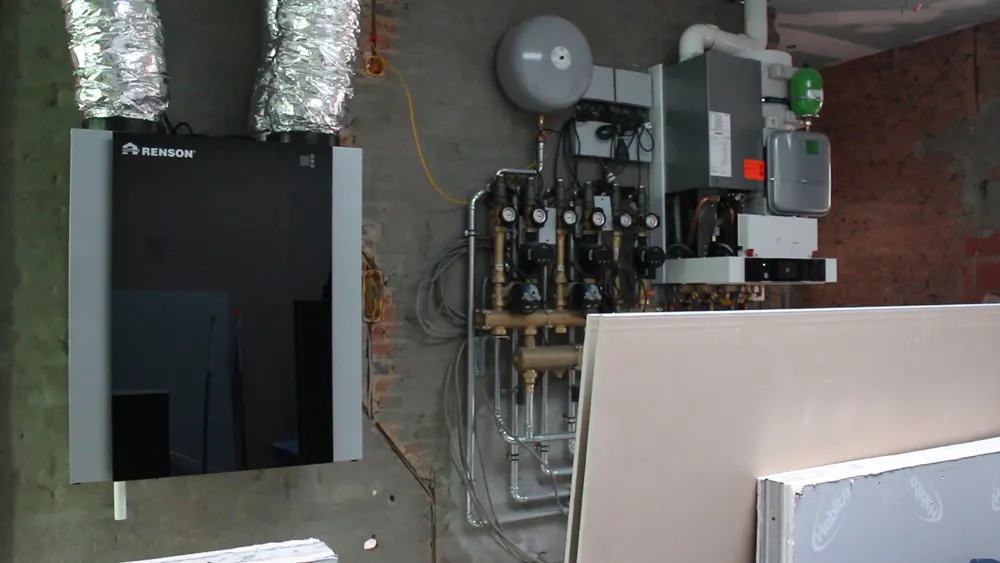
When choosing ventilation for a small-scale or major renovation, is a C or D system the better option? It is the million-dollar question, but ventilation specialist Renson says there is no one-size-fits-all answer.
Although a C system has the advantage of requiring only one duct network, for extract air, a D system can also be a feasible and desirable solution in some cases.
Renovation is playing an increasingly important role in the construction sector. Renson urges people not to overlook ventilation when renovating. “A great deal of attention is still being paid to thorough insulation and the airtightness of homes. That is a good thing, but it should never come at the expense of healthy indoor air,” says Roel Berlaen, Communication Officer at Renson. “If you only insulate and make a home airtight without ventilating it, it is impossible to achieve good indoor air quality. This has all kinds of consequences for the home, but especially for the health of its occupants. Particularly when you consider that, on average, we spend 90% of our time indoors. That is why our main aim is to raise awareness: insulation is important, but remember that your home needs a constant supply of fresh air, preferably in a controlled and energy-efficient way.”
C or D?
A key question soon comes up in ventilation circles when a renovation project is being planned: should you choose a C or D system? The difference is well known: a D system provides mechanical supply and extract of fresh outdoor air and polluted indoor air, respectively. With a C system, air enters naturally through window vents above the windows. This means that only mechanical extract is involved. Should you opt for C or D ventilation in a renovation project? For Renson, there is no fixed answer. Roel Berlaen says: “It all depends on the situation. A C system has the advantage of requiring just one duct network, for extracting polluted indoor air. This offers the necessary flexibility in terms of installation, which is certainly an advantage in a renovation. But in some cases, a D system may still be the best choice. Our message to installers is: listen to your customer and make your choice based on their specific situation. Where is the home located? Are the windows being replaced? Will both occupants be going out to work, or not? As a one-stop supplier, Renson can assure installers that we have the right solution for every project.”
Installation company Juvah also regularly faces this question. “C system or D system: it is a question that customers keep coming back to. We simply use our expertise to find the best solution for each customer. A C system is often the obvious choice for a renovation, because it is slightly easier to conceal everything,” says Roel Cools, Training Manager at Juvah.
Preserving the character of the windows
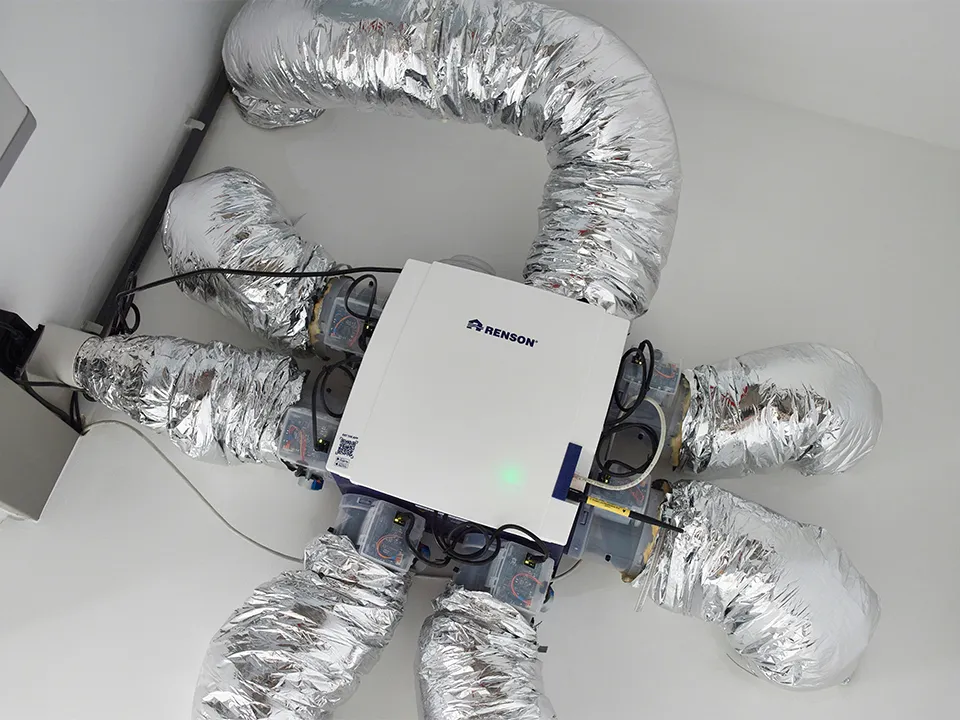
However, Juvah does not always choose a C system. For the complete renovation of a townhouse in Berchem, Antwerp, the installation company opted for a D system. “We wanted to preserve the character of the windows, so window vents were not an option. That is why we chose a D system without hesitation. Another important advantage is that a D system includes heat recovery, with a heat exchanger at the heart of the unit. This uses the warm air being extracted from indoors to heat the cold air coming in from outside. The supply air is also filtered within the system itself, resulting in even cleaner air. It is important, though, to tell customers that the ducts need to be cleaned regularly and the filters replaced.”
For Renson, the Berchem project proves that a D system can work perfectly well in a renovation. “It just takes a little more planning to conceal the double duct network, for supply and extract, and space is also needed for the unit itself, which makes good preparation all the more important. With the necessary planning and design work, it is possible to develop a viable plan in advance,” says Berlaen.
Demand-controlled operation
At Renson, both the C system, Healthbox 3.0, and the D system, Endura Delta, operate on a demand-controlled basis. Cools says: “The unit contains sensors that respond to humidity, CO2 and VOCs (odours). They make the system increase ventilation automatically when indoor air quality is poor. When someone takes a shower, humidity levels rise. The unit detects this and automatically ‘speeds up’. This increases air circulation and ensures optimal air renewal in the home.”
Renson Sense: ‘What gets measured gets managed’
Although humidity and harmful substances also affect indoor air quality, CO2 is a good indicator of it. If CO2 levels rise to an alarmingly high level, it means the air breathed out by the occupants is not being refreshed sufficiently. In airtight, well-insulated and unventilated rooms in particular, CO2 levels can quickly exceed 1,200 ppm (parts per million). At that point, the indoor air can no longer be considered healthy. The new Renson Sense continuously monitors indoor CO2 levels and indicates when they rise too high. But Sense is more than a CO2 meter: it also monitors humidity, sound, light and temperature in the home.
“This intuitive device, which uses colour codes to show indoor air quality, could also be an interesting product for installers to offer their customers,” says Berlaen. “There is currently a lot of awareness around air quality in places such as schools and public buildings, but it is also worth paying more attention to it in the residential sector. ‘What gets measured gets managed’, and that certainly applies to Renson Sense. The device measures all the relevant air quality parameters, including levels of harmful substances, temperature, humidity and light. This means customers and installers can immediately see whether there is a problem, and the installer can use the diagnosis to provide an effective solution and a healthy indoor climate.”
Question about this story? Ask your question
Keep following this
Get an email when a new story is published. No account needed.
- ThemeHealthy air and summer comfort
- SubjectNews







