











Bosch invests billions in climate-neutral technology

In the 2021 financial year, Bosch achieved a substantial increase in sales and profits despite challenging conditions. The technology and services company’s sales rose by 10.1 per cent to 78.7 billion euros, while earnings before interest and taxes (operating EBIT) increased by more than half to 3.2 billion euros. The operating EBIT margin rose to around 4 per cent, compared with 2.8 per cent in the previous year. “The successful 2021 financial year gives us confidence that we will also be able to rise to the challenges of the current year,” said Dr Stefan Hartung, Chairman of the Board of Management of Robert Bosch GmbH, presenting the annual results.
Successful 2021 financial year: uncertainties and rising costs weigh on outlook for the coming year
- 2021: Sales: 78.7 billion euros / Earnings: 3.2 billion euros.
- Entry into the 14-billion-euro hydrogen electrolysis market: Bosch will invest almost 500 million euros in this new business activity by 2030.
- Order volume for electromobility exceeds ten billion euros for the first time.
- Stefan Hartung: “Electrification is the fastest route to a climate-neutral life.”
- Markus Forschner: “Bosch has risen to the challenges of 2021, but pressure on performance is increasing.”
- Filiz Albrecht: “In these times of change, we are taking responsibility for society by redeploying as many employees as possible to new business activities.”
- Christian Fischer: “Bosch will invest 300 million euros in the heat pump sector by 2025.”
- Rolf Najork: “Connected energy management delivers energy efficiency in factories.”
- Markus Heyn: “Bosch is the leading supplier of electric powertrains on the road.”
The war in Ukraine and all its consequences are among the major uncertainties. The company takes its responsibility for its employees particularly seriously and has provided extensive humanitarian aid since the first day of the war, especially to alleviate the suffering of refugees. “Our thoughts are with the people fighting to survive, and we share their fears,” said Hartung. War is not a way to resolve political conflicts. According to Hartung, the current situation illustrates that politicians and society must act urgently to reduce dependence on fossil fuels. They must therefore get to work decisively on developing new energy sources. That is why the Bosch Group continues to make determined efforts to protect the climate, despite the challenging economic climate. In this context, the Bosch chairman announced investments of around three billion euros in climate-neutral technologies such as electrification and hydrogen over the next three years.
According to Hartung, the war will slow the decline in CO2 emissions in the short term, but in the long term, particularly in Europe, it will lead to an accelerated technological transformation. “This situation could spur politicians to act with greater determination, for example by promoting energy-efficient building renovations, but also by enabling a large-scale expansion of renewable energy generation,” said Hartung. He believes electrification is the fastest route to a climate-neutral life, provided, of course, that green electricity is used. To this end, Bosch is promoting sustainable mobility: in 2021, Bosch’s order volume for electric mobility exceeded ten billion euros for the first time. Hartung emphasised, however, that hydrogen also has a role to play. “Industrial policy should prepare all economic sectors for the use of hydrogen,” he believes. “Electricity-based solutions are the top priority, but hydrogen-based solutions also need to gain ground. We need both for sustainable living on the blue planet.” At the same time, the Bosch chairman announced that the company would invest an additional ten billion euros in its digitalisation over the next three years. “Digitalisation can also make a particular contribution to sustainability, and our solutions are built on that conviction,” said Hartung. Examples from Bosch’s product portfolio include the Smart Home energy manager and the energy platform for digitalised industrial production.
Outlook for 2022: major uncertainties in a challenging environment
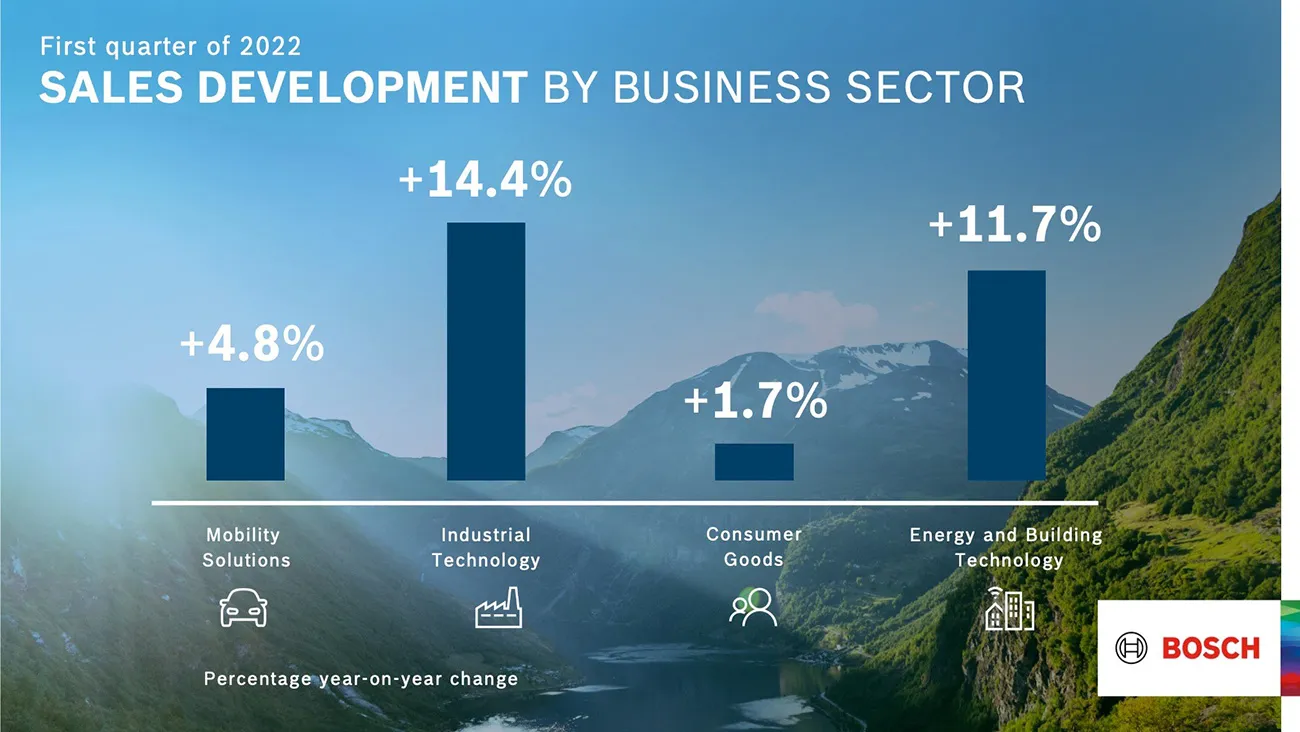
The Bosch Group recorded a 5.2 per cent increase in sales in the first quarter. “We have made a good start to 2022 and, so far, we expect to exceed the 6% sales growth stated in the annual report,” said Dr Markus Forschner, member of the Board of Management and CFO of Robert Bosch GmbH. “Given the many uncertainties, it remains difficult to make an accurate estimate for this year at this stage.” According to the CFO, the company will not quite match last year’s EBIT margin, which should be between 3 and 4 per cent. “Pressure on our results is increasing significantly, particularly because of rising energy, materials and logistics costs.” The Mobility Solutions business sector in particular is currently facing strong price pressures: the prices of certain raw materials have almost tripled since 2020. “We must be prepared for persistently high prices and particularly volatile markets,” said Forschner. “Not only car manufacturers but also suppliers have no choice but to pass on price increases.”
Against the backdrop of the current situation, Bosch has already substantially revised its economic forecasts. The company expects the global economy to grow by almost 3½ per cent in the coming year, down from around 4 per cent at the beginning of the year. The company’s earlier forecast of production of around 88 million vehicles, and an expected increase of 9 per cent on the previous year, will also not be met. According to Forschner, the renewed deterioration is due to the coronavirus pandemic in China and continuing bottlenecks in the semiconductor industry. Overall, however, the CFO remains confident: “Bosch will also master this difficult phase. Future-focused products and a clear long-term strategic direction are important, and we have both.”
Hydrogen electrolysis: entry into the 14-billion-euro market
To protect the climate effectively, Bosch is entering the hydrogen electrolysis components sector. Bosch plans to invest almost 500 million euros in this new business activity by the end of the decade, half of it by the market launch, which is already planned for 2025. “We have a strong foundation for developing hydrogen technologies and want to promote hydrogen production in Europe,” said Hartung. “We expect the global market for electrolyser components to be worth around 14 billion euros in 2030.” Bosch’s stack provides the core of hydrogen electrolysis. Combined with power electronics, sensors and a control unit, it becomes a Smart Module. The stacks for H2 production are scheduled to enter series production in 2025.
Sustainability: social responsibility in the age of new energy
Bosch supports the European Union’s Green Deal and is particularly committed to sustainability: with its 400 sites worldwide, Bosch has been climate-neutral since 2020 and is moving towards an even more climate-neutral business much faster than planned. Bosch has already achieved one third of the energy savings it has set itself as a target by the end of the decade. “Sustainability is no longer a sideshow; it must be part of every company’s core business,” said Filiz Albrecht, member of the Board of Management and Director of Industrial Relations at Robert Bosch GmbH, responsible for the sustainability strategy. Bosch’s social responsibility lies at the intersection of economic, social and environmental interests. “It is not easy to strike a balance between these three. For us, social responsibility during a period of change means redeploying as many employees as possible to new business activities.” According to the Director of Industrial Relations, Bosch is developing climate-neutral technologies particularly at sites where combustion engine systems were previously manufactured. 1400 employees in the Powertrain Solutions division have already been able to move into new roles, for example in software and electromobility, based on their qualifications or through an internal job placement platform. “By the end of the year, almost 2300 employees will be working on mobile and stationary fuel cell systems, most of them existing employees. That is transformation, made by Bosch,” said Albrecht. “The company also plans to recruit 10 000 new software developers worldwide this year,” added the Director of Industrial Relations.
Thermotechnology: 300 million euros for the heat pump sector
“Climate protection matters in our homes too, as buildings account for more than one third of CO2 emissions,” said Dr Christian Fischer, Deputy Chairman of the Board of Management of Robert Bosch GmbH, responsible for the Consumer Goods and Energy and Building Technology business sectors. “The transition to low-carbon heating starts with the heat pump, ideally powered by green electricity.” More and more legislators are setting corresponding requirements for new buildings internationally: in Germany alone, 65 per cent of new heating systems must be powered by renewable sources by 2024. “Bosch will invest an additional 300 million euros in the heat pump sector by the middle of the decade,” Fischer explained. “The market will grow by 15 to 20 per cent a year until 2025. We want to grow twice as fast as the market.” Bosch also wants to do its bit in existing buildings: the company supports the conversion of natural gas heating systems to hydrogen with H2-compatible gas boilers. In addition, by connecting and integrating building systems, Bosch is moving closer to its goal of generating a fundamental share of its revenue from services. “In the building systems sector, we already earn almost half of our revenue from services,” said Fischer. “Our strategic goals complement one another: they help us shape climate protection from a technological perspective and expand our services.”
Industrial technology: digitalisation drives energy efficiency
In industrial manufacturing, Bosch is focusing on energy and cost efficiency in its factories. “Digitalisation in industrial manufacturing helps protect the climate,” says Rolf Najork, who is responsible for the Industrial Technology business sector. “Connected energy management alone enables us to reduce the annual energy consumption of our production operations by an average of five per cent.” The Energy Platform, part of the Industry 4.0 portfolio, is already being used in 80 customer projects and at 120 Bosch sites. At the same time, the Bosch Group is focusing on electrification in industrial technology, Najork continues. By 2030, an estimated 30 per cent of mobile machinery will be electrified. This represents an additional market volume of 1.5 billion euros for high-voltage drives. Bosch also wants to use industrial technology to promote electric mobility. “We are working hard in a joint project office with VW to set up a company that will equip battery cell factories in Europe,” Najork explains. “Our shared goal is to become the cost and technology leader in the industrialisation of battery production.” Experts worldwide expect the cumulative market volume for battery cell production technology to reach 50 billion euros by 2030.
Transport transition: electrification with battery and fuel cell powertrains
According to Bosch, the EU Green Deal will provide a decisive boost to the electrification of road transport. “All car manufacturers are seeking to secure the largest possible share of the growing electric vehicle market,” says Dr Markus Heyn, who is responsible for the Mobility Solutions business sector. “Bosch sees itself as the leading supplier of electric powertrains for vehicles.” The company is focusing on one key technical challenge: keeping the powertrain, including the battery, at the right temperature while providing the necessary cabin climate comfort. Intelligent thermal management alone increases the range of electric vehicles by 25 per cent. To address this, Bosch has developed a pre-integrated solution called the FlexibleThermal Unit, or FTU. With the FTU, Bosch is tapping into a market expected to reach 3.5 billion euros by the end of the decade. In fuel cell electric mobility, Bosch will start series production of fuel cell powertrains for trucks this year. “At the Bamberg site, we want to produce stacks with an output of one gigawatt by the middle of the decade,” Heyn says, looking ahead. “Our goal is for the cost of a fuel cell truck powertrain to be exactly the same as that of a diesel truck by 2030.” Bosch has increased its investment in mobile fuel cells once again, to almost one billion euros between 2021 and 2024.
2021 financial year: challenges overcome despite cost pressures
“The Bosch Group successfully overcame the challenges of 2021,” says Forschner. “We achieved a 10.1 per cent increase in sales and more than doubled our operating EBIT.” This was achieved despite the ongoing coronavirus pandemic, persistent bottlenecks in the supply of semiconductors and the significant rise in raw material prices, which had already become apparent in the 2021 financial year. “Alongside strong sales figures, our extensive range of cost-saving measures also paid off,” the CFO explains. “Our focus on the future is also reflected in our solid annual accounts.” The Bosch Group’s research and development costs remained stable at 6.1 billion euros (2020: 5.9 billion euros), while investment rose slightly to 3.9 billion euros (2020: 3.3 billion euros). Expenditure on research and development focused on electric mobility and driver assistance systems, as well as industrial electrification and heating technology. Equity increased by 1.3 percentage points to 45.3 per cent.
2021 financial year: performance by business sector
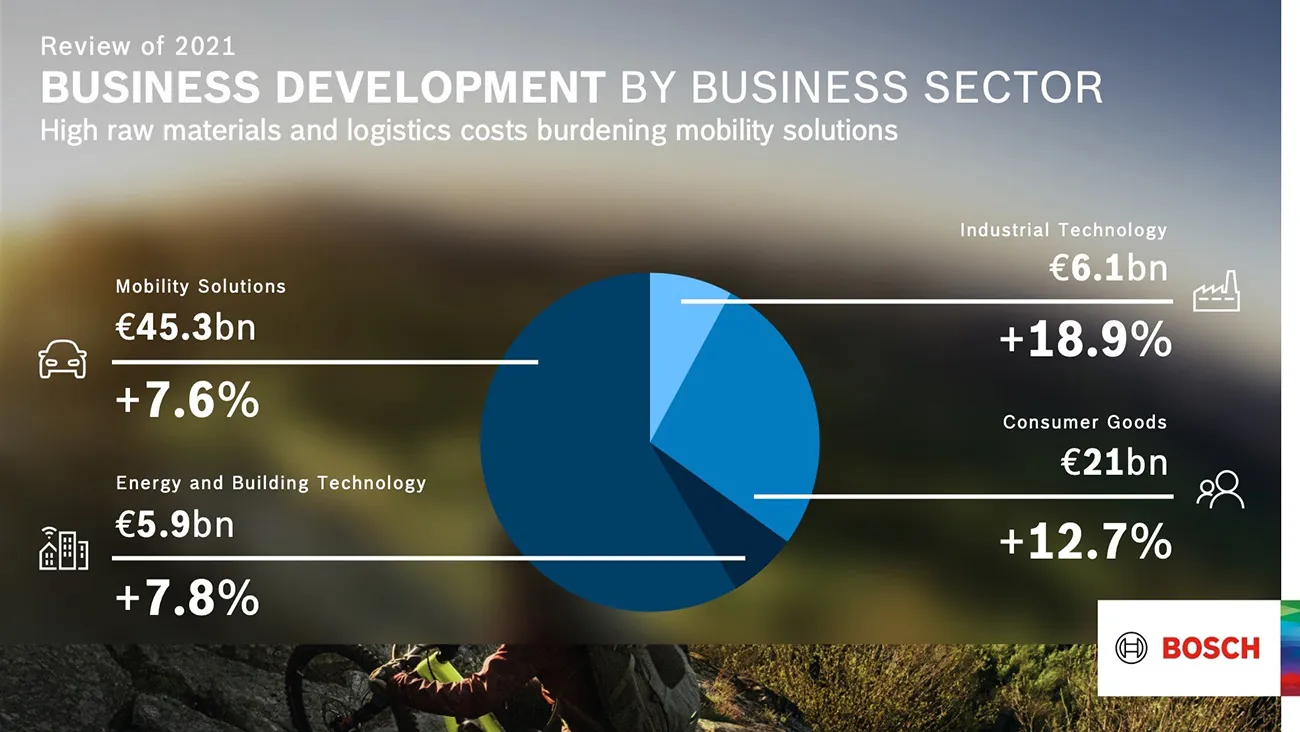
All sectors contributed to the positive performance of the business. The largest business sector by sales, Mobility Solutions, recorded a 7.6 per cent increase in sales to 45.3 billion euros. Adjusted for exchange rate effects, this was an increase of 7.9 per cent. Following the previous year’s loss, the sector achieved a slightly positive result, with an operating EBIT margin of 0.7 per cent. “Mobility Solutions has been particularly affected by semiconductor supply bottlenecks and has had to adapt to far-reaching changes in the mobility sector,” Forschner explains. “At the same time, the sector is making substantial advance investments in electric mobility and automated driving, and has faced significantly higher raw material and logistics costs.” The Industrial Technology business sector benefited from a recovery in key mechanical engineering markets, achieving sales growth of 18.9 per cent to 6.1 billion euros. Adjusted for exchange rate effects, this was an increase of 19.4 per cent. The EBIT margin was 8.4 per cent. The Consumer Goods business sector increased its sales by 12.7 per cent to 21 billion euros compared with an already strong previous year, an increase of 14.4 per cent after adjustment for exchange rate effects. The sector once again achieved a double-digit operating EBIT margin, at 10.2 per cent. The Energy and Building Technology business sector generated sales growth of 7.8 per cent, or 8.8 per cent after adjustment for exchange rate effects. Its improved EBIT margin was 5.1 per cent, on total sales of EUR 5.9 billion. Forschner explains: “Our climate-friendly heating technology made an important contribution to our success.”
2021 financial year: performance by region
The Bosch Group recorded sales growth in all regions. In Europe, sales amounted to 41.3 billion euros, an increase of 8.9 per cent on the previous year. Adjusted for exchange rate effects, the increase was 10 per cent. In North America, sales rose by 6.5 per cent to 11.4 billion euros, or 9.3 per cent after adjustment for exchange rate effects. In South America, sales amounted to 1.4 billion euros. Sales rose by 32 per cent, or as much as 45.1 per cent after adjustment for exchange rate effects. In Asia-Pacific, including other regions, sales amounted to 24.5 billion euros. This was an increase of 13.1 per cent, or 11.7 per cent after adjustment for exchange rate effects.
2021 workforce figures: growth in all regions
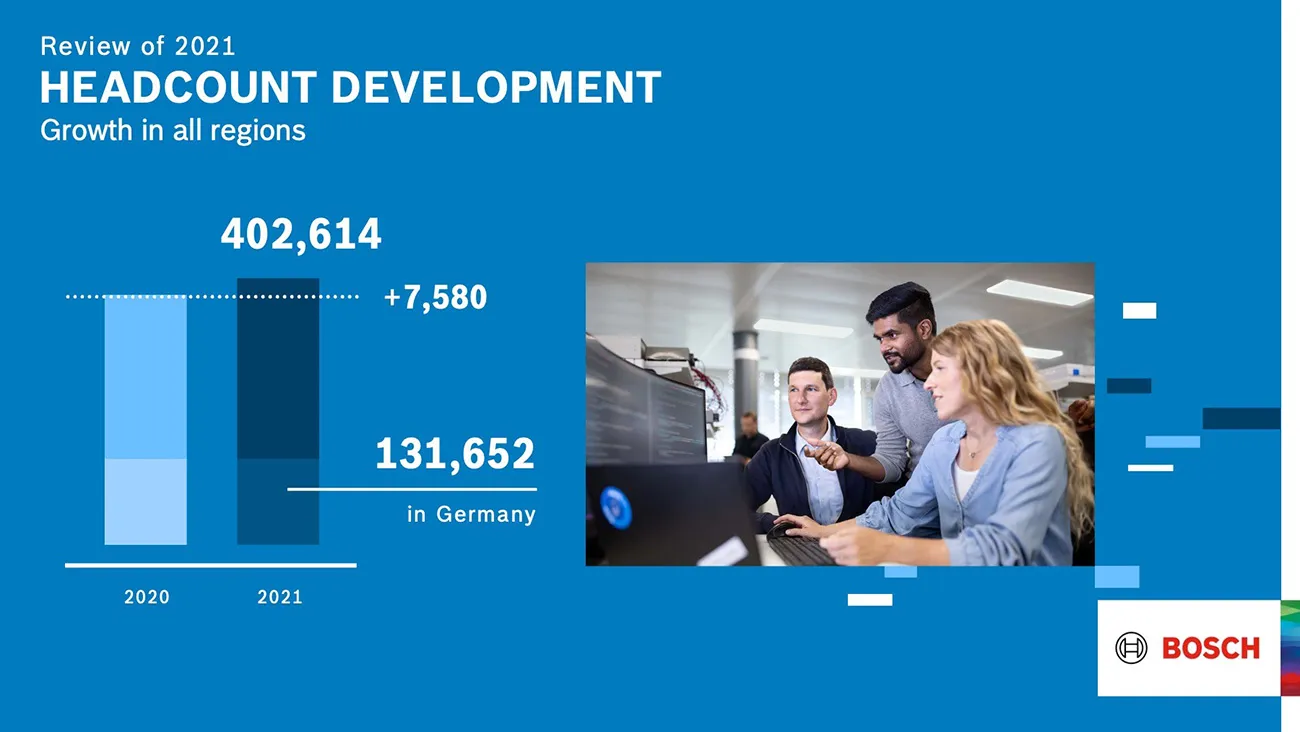
On 31 December 2021, the Bosch Group employed 402,614 people worldwide, 7,580 more than in the previous year. The workforce grew in all regions: Europe, the Americas and Asia. In Germany, the number of employees remained stable at 131,652. The number of employees in research and development rose by 2,949 to 76,121.
Question about this story? Ask your question
Companies in this story
Keep following this
Get an email when a new story is published. No account needed.
- SubjectNews
- CompanyFischer







