











Bosch focuses on innovation, partnerships and acquisitions, while cost reduction remains a priority
Growth targets require high profitability and financial strength
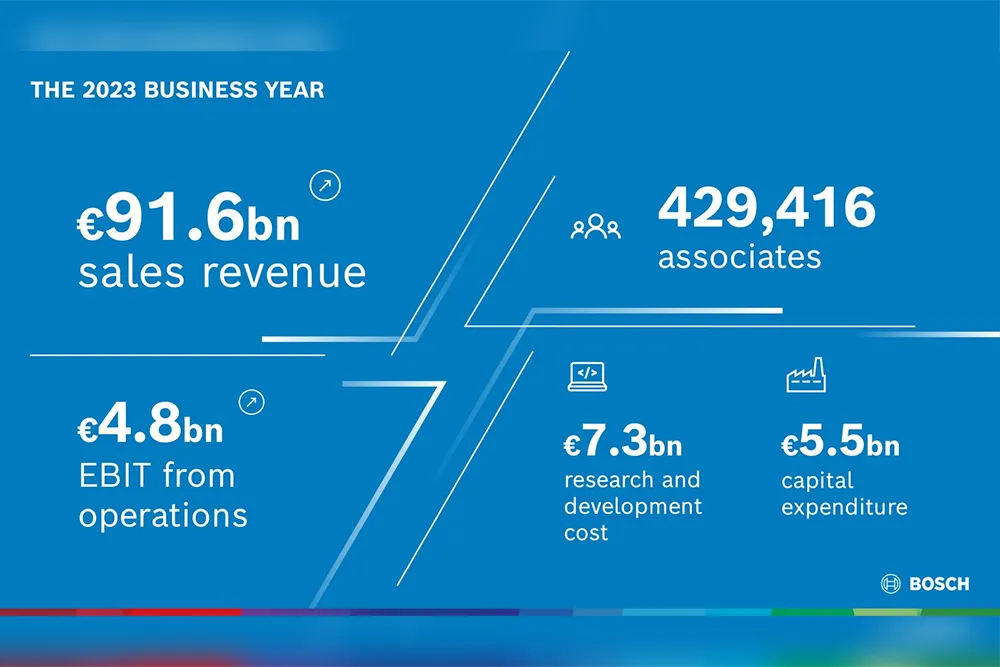
- Progress in the 2023 financial year: sales rose to 91.6 billion euros / EBIT margin from operations reached 5.3 per cent for the year
- Outlook for 2024 remains subdued: expected sales growth of 5 to 7 per cent / EBIT margin expected to be no higher than last year’s level
- Despite ongoing challenging economic conditions, Bosch recorded growth of 11% in Belgium compared with the previous year
- Expansion focuses on growth areas: medical technology as an example, with 300 million euros in investment alongside two new partners
- Stefan Hartung: “We are focusing on innovation, partnerships and acquisitions. Despite the economic headwinds, this will enable us to continue growing and make the most of our opportunities as our industries transform.”
- Markus Forschner: “Our targets for 2024 are very ambitious. We do not expect any economic tailwinds and must further reduce costs to remain competitive.”
The Bosch Group increased its sales and earnings in 2023 and is successfully implementing its growth strategy despite a challenging environment. At the presentation of the company’s annual results, Stefan Hartung, chairman of the board of management of Robert Bosch GmbH, said: “In the 2023 financial year, we achieved our financial targets and strengthened our market position in a number of business areas, from semiconductors to integrated building systems. We are focusing on innovation, partnerships and acquisitions to secure further growth as our industries transform, despite the economic headwinds.” The technology and services supplier aims to achieve average annual growth of 6 to 8 per cent over the long term, with a margin of at least 7 per cent. Bosch also aims to rank among the top three suppliers in its key markets in every region of the world.
Bosch is also strategically expanding its innovation areas with growth potential. The company has announced that it is working on a new BioMEMS technology for medical technology, combining molecular diagnostics with microsystems technology. The technology enables precise testing for up to 250 genetic traits, such as pathogens or genetic mutations, on a single chip and directly at the point of care, for example in a doctor’s surgery. “BioMEMS combines modular diagnostics with the microsystems technology Bosch already uses in smartphones and ESP anti-skid systems,” says Hartung. One of the first BioMEMS tests the company is developing targets various pathogens that cause sepsis or blood poisoning. Bosch recently entered into a development and sales partnership with Randox for this purpose. A further strategic partnership with r-Biopharm is intended to accelerate the development of a fully automated test for multidrug-resistant bacteria. Together with these two partners, Bosch will invest approximately 300 million euros by 2030.
Sales and earnings improve in 2023, while 2024 remains challenging
In the past financial year, Bosch achieved sales of 91.6 billion euros despite unfavourable economic and market conditions. This represents an increase of 3.8 per cent, or 8.0 per cent adjusted for exchange-rate effects. Earnings before interest and taxes (EBIT) amounted to 4.8 billion euros (2022: 3.8 billion euros). The EBIT margin from operations was 5.3 per cent, 1 percentage point higher than the previous year. This was better than expected, but still below the long-term target margin of at least 7 per cent. Bosch aims to achieve this margin by 2026. “We need high profitability and strong financial resources to fund as much of our growth targets as possible ourselves,” says Markus Forschner, member of the board of management and chief financial officer of Robert Bosch GmbH. “A strong finish to 2023 helped us meet our expectations. But the 2024 financial year will be at least as challenging as 2023.”
Bosch’s overall outlook for the current year remains subdued, particularly in light of the current economic environment. “We do not expect any economic tailwinds in 2024,” says Forschner. He expects global economic growth of just 2.3 per cent in 2024, alongside stagnant vehicle production and continued weakness in the mechanical engineering market. The consumer goods market, on the other hand, could improve slightly after two years of consumer restraint. Bosch expects its own business to stabilise, thanks both to innovation and to the expansion of its international footprint. A new cooker factory is currently being built in Egypt, for example, along with a refrigerator factory in Mexico.
In the first quarter of 2024, sales fell by 0.8 per cent year on year; adjusted for exchange-rate effects, this equates to an increase of 2.7 per cent. “This clearly shows that the 5 to 7 per cent sales growth we are targeting for the full year is very ambitious,” Forschner adds. According to the CFO, improving the EBIT margin from operations compared with last year will be difficult: “We are not only facing a subdued market environment and an expected further increase in upfront investment in strategically important areas. Restructuring and process improvements will also initially have a negative impact. It will therefore take some time for their positive effects to become tangible.” Bosch also wants to further reduce costs and adjust its structures to remain competitive as its industries transform. As Forschner puts it: “We will implement the necessary measures consistently, but with a sense of proportion.” Any workforce adjustments will be made without compulsory redundancies and in consultation with the social partners.
Business performance in Belgium: growth in 2023
Bosch in Belgium closed the 2023 financial year with consolidated sales of almost 914 million euros, an increase of 11% compared with the previous year. “Despite the ongoing challenging economic conditions, we managed to achieve positive growth in Belgium in the 2023 financial year,” says Patrick Incoletti, director of Bosch Benelux. Bosch’s sales in Belgium increased, mainly thanks to the performance of the Mobility business sector. As at 31 December 2023, the Bosch Group had approximately 1,160 employees in Belgium. Bosch’s outlook for Belgium for the current financial year is subdued in light of ongoing global economic and geopolitical challenges. “Although we expect a challenging year in Belgium, we will continue to strengthen our position and long-term potential in the local market,” Incoletti explains.
Bosch in Belgium remains committed to making its office buildings and factories more sustainable. “Our site in Anderlecht now also has solar panels to generate its own energy,” Incoletti continues. To contribute further to Bosch’s climate action, Bosch in Belgium introduced the BrefurbiSH initiative. This collaboration between Sirris, Circular.brussels, Lichtwerk and BSH Home Appliances aims to make the refurbishment process for household appliances more efficient through advanced data analysis and cognitive and functional support for operators. Bosch aims to divert 50 tonnes of appliances from the waste stream each year.
Bosch in Belgium is also continuing its work on road safety. At the end of 2023, Flanders became the first region in the world with a real-time detection system that sends personalised warnings via in-car navigation apps both to wrong-way drivers and to drivers in the vicinity of a wrong-way driver. The system was developed by Bosch and is part of the Flemish government and imec’s Mobilidata programme.
Growth area: sustainable mobility
In its core mobility business, Bosch is continuing to make strategic decisions for future growth. This year alone, the company is launching around 30 production projects for electric vehicles. “Electromobility is coming. The only question is how quickly it will take off in different parts of the world,” says Hartung. “We estimate that 70 per cent of all new cars in Europe will be fully electric by 2030. This figure is likely to be 40 to 50 per cent in China and North America.” Where heavy vehicles are needed to cover long distances, demand for solutions such as plug-in hybrid powertrains and range extenders will, according to the Bosch chairman, continue for some time. The Mobility business sector expects a further boost from vehicle dynamics. With new and redundant braking systems designed for electric and automated driving, Bosch is growing by 10 per cent a year, considerably faster than the market. And with Vehicle Motion Management (VMM), Bosch is developing an innovative system solution that coordinates all aspects of vehicle motion by controlling the brakes, steering, powertrain and dampers. In recent winter tests alone, Bosch equipped more than 20 vehicles from major brands with VMM variants. “We are ahead of the curve and will secure our first series-production order this year,” says Hartung. The company expects to generate sales of hundreds of millions by 2030.
Growth area: hydrogen
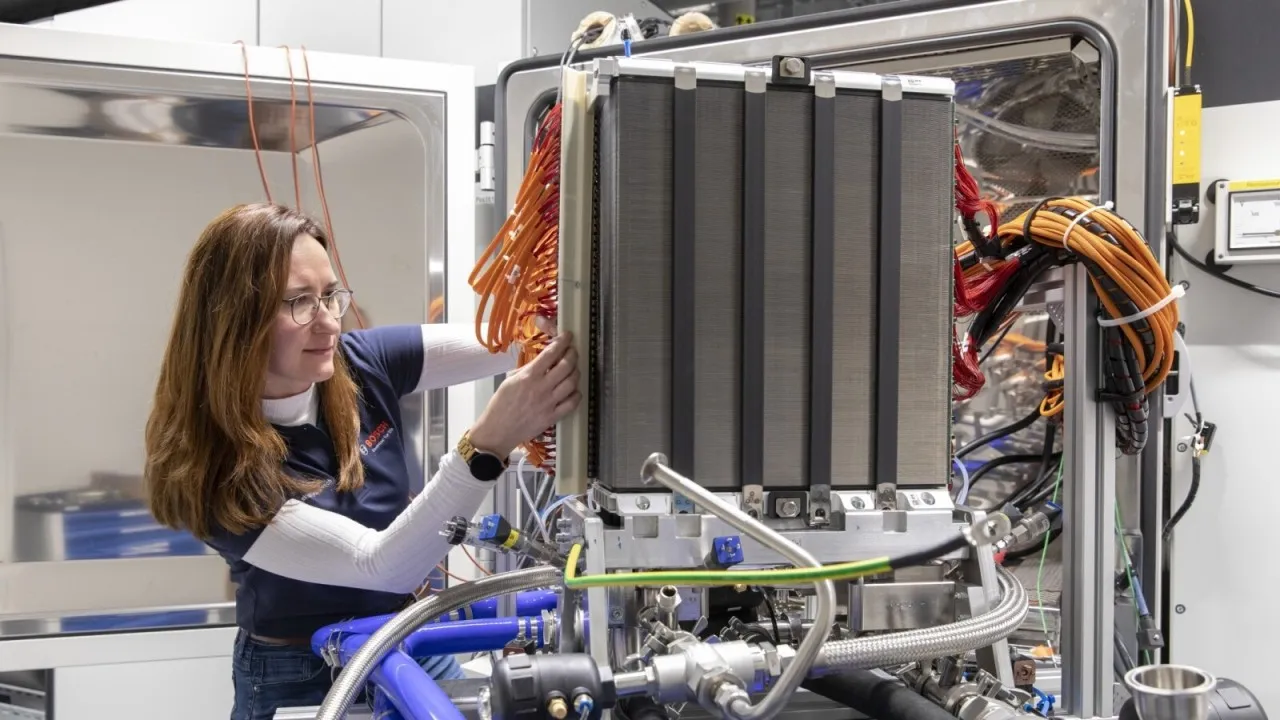
Bosch has reaffirmed its expectations for hydrogen as a growth area: revenue from hydrogen technology could reach 5 billion euros by 2030. “In 2023, we began producing fuel cell systems in Stuttgart, Germany, and Chongqin, China,” says Hartung. China is likely to remain the most important market for the time being. Bosch expects strong growth in Europe and North America only in the next decade. From a technical perspective, hydrogen engines offer the fastest route to climate-neutral truck transport. Bosch expects the market for this technology to be worth almost 1 billion euros by 2030. The Bosch CEO explains: “This year, trucks with hydrogen engines using our injection technology will already be on the road in India. We are already working on five orders from well-known truck manufacturers in the world’s three main economic regions.” Bosch also wants to enter the fast-growing hydrogen production market: by 2030, global installed production capacity for hydrogen electrolysis will exceed 170 gigawatts. That is around 25 times more than today. “Our electrolysis module is on track for launch next year,” says Hartung. “In future, Bosch will be synonymous not only with hydrogen-powered vehicles but also with hydrogen production. As a supplier, we will actively help shape the market of the future.”
Growth area: heat pumps
Bosch is also systematically capitalising on growth opportunities in heating technology. Although the European heat pump market stagnated in 2023, Bosch increased its revenue by almost 50 per cent. Bosch will continue to grow significantly faster than the market in this segment over the coming years. “We have not only invested in production capacity, but have also expanded our product portfolio with heat pumps that are quiet, efficient and cost-effective,” says Hartung. The Bosch chairman sees further revenue potential in hybrid heating systems: a combination of a heat pump for base-load operation and a gas boiler to meet peak demand. This will enable the efficient decarbonisation of millions of existing buildings. As a first step, Bosch is introducing a solution using this technology for apartment buildings with up to 100 dwellings. Hartung also refers to the controversial debate surrounding Germany’s heating law, which has held back long-term purchasing decisions and severely weakened the heating market. “When climate and energy policies contradict each other, investors do not invest, but wait and see,” he says. “Growth requires a clear and predictable subsidy policy.”
Climate policy: a carbon-neutral future requires sustainable investment
Climate action remains central to Bosch. According to Hartung, it offers significant growth opportunities, even if markets such as electric mobility are developing more slowly than expected. “Yet we see that climate action is no longer the only challenge at the top of the political agenda, given the complex geopolitical situation and growing social tensions in our society,” he says. Nevertheless, Bosch continues to make substantial upfront investments in technologies for a carbon-neutral future, to shape this transformation from the outset. Hartung explains: “Support for CO2-efficient technologies is under pressure. But climate action requires sustained investment by governments, businesses and each of us.”
2023 financial year: improved free cash flow, substantial upfront investment
While Bosch’s inventory levels last year were still heavily affected by the uncertainties following the COVID-19 pandemic and the shortage of chips, the situation is now returning to normal. As a result, free cash flow improved to 2.2 billion euros. This corresponds to 2.4 per cent of revenue and is above the minimum target of 1.0 per cent. The equity ratio was 44.2 per cent (2022: 46.6 per cent). Research and development expenditure remained stable at a high level of 7.3 billion euros (2022: 7.2 billion euros), resulting in an R&D ratio of 8 per cent (2022: 8.2 per cent). Capital expenditure reached a new high of 5.5 billion euros (2022: 4.9 billion euros). Forschner explains: “We are also paying close attention to the cost-effectiveness of our upfront investments, which exceeded 12 billion euros in 2023, and adjust our projects where necessary.”
2023 financial year: developments by business sector
The Mobility business sector recorded revenue growth of 6.9 per cent to 56.2 billion euros. Adjusted for exchange-rate effects, growth amounted to 10.9 per cent. The EBIT margin from operations was 4.4 per cent (2022: 3.4 per cent). Revenue in the Industrial Technology business sector rose to 7.4 billion euros. This growth of 6.8 per cent (10.2 per cent adjusted for exchange-rate effects) was attributable to the initial consolidation of the acquisitions of HydraForce and Elmo Motion Control. The EBIT margin remained stable at 9.1 per cent (2022: 9.8 per cent). In the Consumer Goods business sector, revenue was 19.9 billion euros, down 6.6 per cent on the previous year, or a slight decline of 1.2 per cent when adjusted for exchange-rate effects. The EBIT margin from operations remained unchanged at 4.5 per cent. In the Energy and Building Technologies business sector, revenue rose by 10.5 per cent to 7.7 billion euros, or by 13.2 per cent when adjusted for exchange-rate effects. The EBIT margin from operations was 9 per cent (2022: 6 per cent).
2023 financial year: developments by region
In Europe, revenue was 46.8 billion euros. This represents an increase of 5.5 per cent on the previous year, or 7.9 per cent when adjusted for exchange-rate effects. In North America, revenue rose by 6.2 per cent to 15.2 billion euros. Adjusted for exchange-rate effects, this represents growth of 8 per cent. Revenue in South America reached 1.7 billion euros, compared with 1.8 billion euros the previous year. Adjusted for exchange-rate effects, this 6.2 per cent decline represents growth of 1.8 per cent. In Asia-Pacific, including other regions, revenue was 27.9 billion euros. Adjusted for exchange-rate effects, this slight growth of 0.6 per cent represents a substantial increase of 8.6 per cent.
2023 financial year: workforce grows by around 2 per cent
At the end of the year, the company had 429,416 employees worldwide, 8,078 more than the previous year. Employee numbers rose in all regions, including Germany. The strongest regional growth was recorded in the Americas.
Question about this story? Ask your question
Keep following this
Get an email when a new story is published. No account needed.
- SubjectNews







