











A major step towards green buildings
Buildings and the construction sector account for almost 40% of global carbon emissions, making information about the environmental impact of buildings essential to driving the construction sector’s green transformation. A number of countries have already established national life-cycle carbon limits for both new and public buildings. In some countries, reporting carbon emissions is a minimum requirement, while others have generally introduced stricter requirements for new construction projects.
GROHE reveals the environmental impact of its products by publishing EPDs
- Industry first: GROHE to launch Environmental Product Declarations (EPDs) for more than 600 products at the end of October
- Product passports: EPDs provide transparent and comparable data on the environmental impact of products throughout their entire life cycle.
- LIXIL’s positive impact on the environment: focusing on sustainable construction through better product selection reduces the ecological footprint and negative impact on the climate.
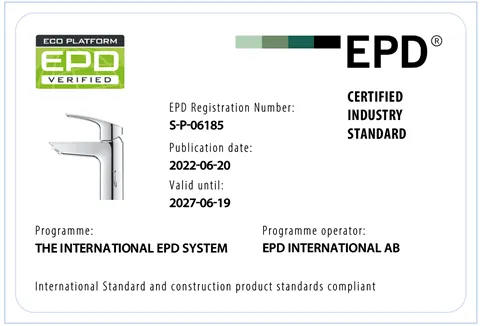
The European Commission considers Environmental Product Declarations (EPDs) a suitable means of evaluating a building’s sustainability, since the materials used determine a large part of its environmental impact. To provide customers with the necessary transparency about the ecological footprint of its products, GROHE will publish EPDs, or product environmental passports, for more than 18 product categories covering over 600 products by the end of October. The first set will be published at the end of July 2022 and will cover GROHE’s washbasin and kitchen taps, thermostats and shower rail sets. A second set will follow at the end of October, covering hand showers, installation systems, flush plates and specialist taps.
“By launching EPDs for a large part of our portfolio, we are giving our customers a simple and transparent way to compare the life-cycle assessments of products. This enables them to make well-founded statements about the environmental impact of buildings, which is often a cornerstone of sustainability certifications such as DGNB, LEED or BREEAM. In many European cities, these certificates are even required to obtain a building permit. The construction sector is under increasing pressure to make buildings more sustainable, driving growing demand for information about the sustainability of products. In time, sustainability will become a selection criterion, valued by consumers as much as price or design,” says Jonas Brennwald, Leader LIXIL EMENA.
Transparency to promote sustainable construction projects
An EPD is a comprehensive, independently verified environmental passport for a product. It sets out transparent and comparable data on a product’s environmental impacts throughout its entire life cycle. This covers everything from the extraction of raw materials and manufacturing to the use phase and, of course, the product’s end of life, including all transport between stages. Environmental declarations are based on the international ISO 14025 standard. For the construction sector, EPDs are based in particular on EN 15804 for construction products, services and processes.
Tomas Kvillström, Commercial Regulation, LIXIL EMENA stresses the importance of mapping a product’s entire life cycle. “We also looked specifically at a product’s use phase, something the industry has often overlooked in the past. This longest phase is responsible for most water and energy consumption, which is crucial information for property companies and the hotel sector. In any case, this knowledge is not only important for our customers, it is also a useful benchmark for us in improving the sustainability of our products.”
A key building block in our sustainability strategy
Today, sustainable product requirements focus mainly on Global Warming Potential (GWP). By collecting relevant EPD data, GROHE aims to introduce more low-emission processes over the long term while also reducing its own ecological footprint. There is always room for improvement at GROHE, for example by using raw materials that can be sourced closer to its factories, as well as implementing greener transport.
Since 2020, all 8 LIXIL factories where GROHE products are manufactured, in Hemer, Lahr, Porta Westfalica (Germany), Albergaria (Portugal), Klaeng (Thailand), Jiangmen (China), Danang (Vietnam) and Monterrey (Mexico), have been fully CO2-neutral. A year later, all logistics centres in Europe also became CO2-neutral, and all German factories switched to green energy.
The EPD data collected does show clear CO2 peaks, but for GROHE this is an added incentive to support its emissions-reduction target. It also means paying less in compensation. As a brand in the portfolio of LIXIL, the Japanese manufacturer of innovative water and housing products, GROHE’s efforts contribute to LIXIL’s overarching goal of becoming fully CO2-neutral by 2050. “To care for our planet, we need to change the way we build and develop. We therefore welcome EPDs as the new industry standard, helping to ensure a shift towards development projects with low environmental impact and energy consumption. They are a crucial prerequisite for a sustainable future for the sector,” says Jonas Brennwald.
Een zakelijke vraag aan GROHE nv? Get in touch
Companies in this story
Keep following this
Get an email when a new story is published. No account needed.
- SubjectNews
- CompanyGROHE nv







