











‘A few seconds of exposure to UV-C is enough to inactivate the coronavirus’
The global coronavirus figures speak for themselves: more than 23 million infections and more than 800,000 deaths. As it was a new virus, time was needed to investigate its causes and find solutions.
In June 2020, Anthony Griffiths, Professor of Microbiology at Boston University, published the results of an interesting study. Griffiths showed that UV-C light can completely inactivate virus particles.
The coronavirus is transmitted in virus-laden droplets through breathing, talking, coughing or sneezing. That is now common knowledge. Research into possible solutions is therefore focused primarily on breaking this chain of transmission. “There is a need for devices that can be used to inactivate the virus on both recently contaminated and longer-contaminated surfaces,” Griffiths and his colleagues say in their study.

How UV-C works
UV-C is not new, including in disinfection applications. The first UV-C water treatment plant was commissioned in Marseille as early as 1910. UV light or radiation has a shorter wavelength and carries more energy than visible light. It is divided into UV-A, UV-B and UV-C. UV-C light has a wavelength of 100 to 300 nm, but microorganisms absorb wavelengths in the 240-280 nm range particularly well. The energy from UV-C light disrupts DNA and prevents microorganisms from dividing.
The greatest effect is achieved at a maximum wavelength of 260 nm. This pattern is comparable to the DNA absorption curve. The DNA molecule consists of four building blocks arranged in a double helix: adenine, thymine, guanine and cytosine. When two thymines lie next to each other, UV-C light binds them together instead of binding them to the opposing base in the DNA molecule. The higher the UV-C intensity (expressed in mW/cm²) and the longer the exposure time (seconds), the higher the UV-C dose (mJ/cm²), and therefore the greater the number of microorganisms damaged to the point that they can no longer divide and are killed.
Griffiths’ study shows that UV-C also affects the coronavirus. In the experiment, virus particles, in both dry and wet form, were exposed to radiation produced by a UV-C light source with a wavelength of 254 nm. A lamp from Signify, formerly Philips Lighting, was used. The results were unanimously positive: “Just a few seconds of exposure to UV-C light is enough to completely inactivate the virus. UV-C can easily be incorporated into disinfection procedures. Our results show that UV-C is an affordable and effective way to prevent coronavirus infections through contact transmission.”
Disinfection robots
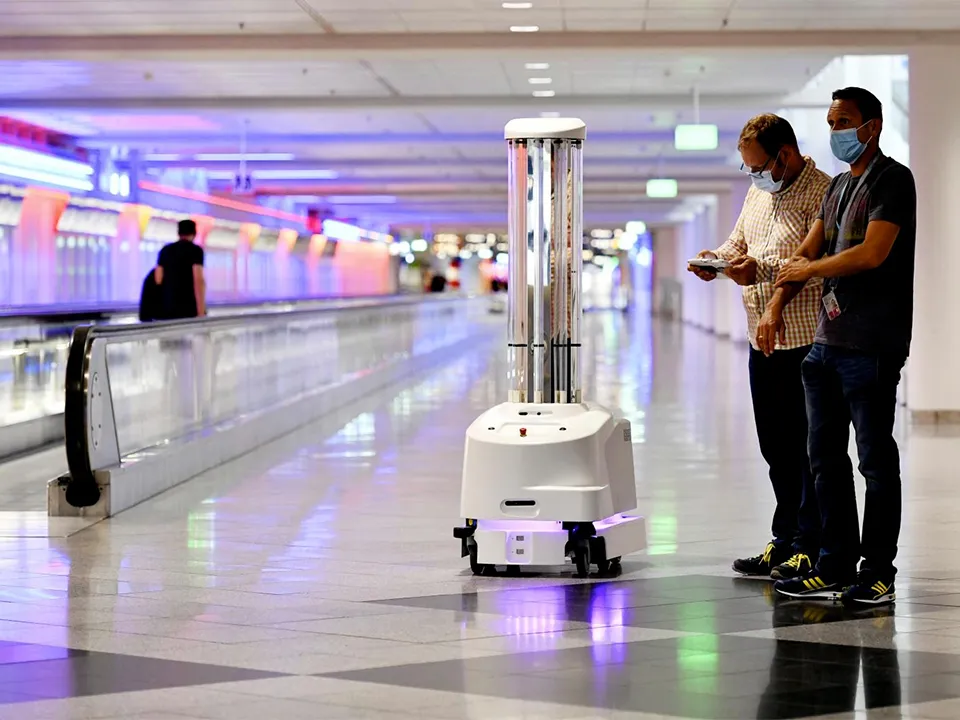
Several other scientists confirm UV-C’s potential. “It really is a universal killer. UV-C light can be used to purify the air or disinfect face masks and shopping trolleys,” Professor Hans Nauwynck, a virologist at Ghent University, told De Tijd. Innovations are now emerging in quick succession: a start-up in Wetteren has developed a UV-C disinfectant for face masks. Meanwhile, autonomous robots from Danish company Blue Ocean Robotics are operating in various locations around the country, disinfecting small and large spaces and navigating around obstacles. The robot can disinfect 15,000 m² in 2.5 hours.
Question about this story? Ask your question
Keep following this
Get an email when a new story is published. No account needed.
- SubjectNews







