Sustainable, efficient ventilation units that exceed ErP requirements
Text and images WOLF Energieystemen
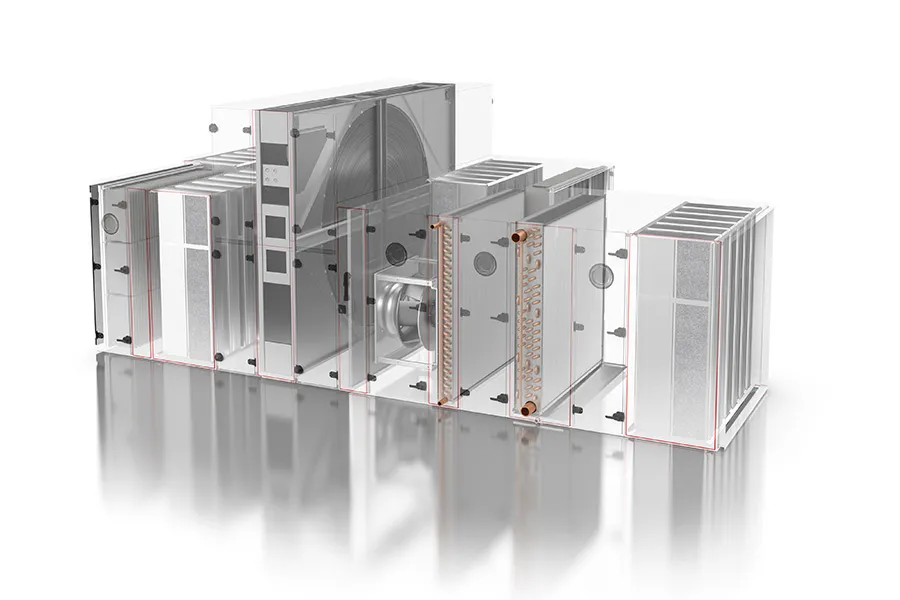
Investing in sustainable, efficient ventilation units with low energy consumption and a small CO2 footprint pays for itself many times over. “The running costs of a unit designed to the WOLF standard are significantly lower than the minimum requirements of the European ErP Directive,” explains Tom Melching, technical adviser at WOLF Energiesystemen.
When supplying fresh air to buildings, the applicable standards and guidelines must be taken into account, as must environmental considerations. “Around 90% of a ventilation unit’s total CO2 emissions are generated during operation,” begins Tom Melching. “Keeping energy consumption for ventilation and air conditioning as low as possible helps reduce those emissions, and of course the costs too.”
Significant savings potential
The European ErP Directive contains a number of provisions designed to limit the environmental impact of energy-related products. ErP Regulation 1253/2014/EC sets out various ecodesign requirements for ventilation units. “The WOLF ventilation unit exceeds these requirements,” says the technical adviser.
He supports this claim with an example. “Let’s compare a WOLF unit in an existing office building in Munich with a hypothetical unit that just meets the current ErP Directive. The WOLF unit’s savings potential compared with that hypothetical unit is 41% for electricity consumption and 7.9% for heat recovery. This not only has a positive effect on CO2 emissions, the additional investment in energy-efficient technology also pays for itself very quickly.”
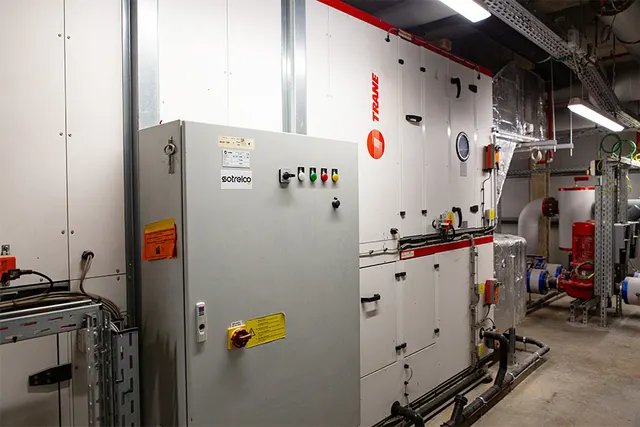
In the Munich project, the existing rented space on the first floor had to be expanded into an office and event space for up to 800 participants. This required an additional air handling unit and a new duct distribution network for the existing unit on the roof. Tom Melching explains: “A total airflow of 22,000 m³/h, with an external pressure of 500 Pa, was required. Due to the limited space, the unit had to be installed in a plant room on the third floor, and the ductwork and associated installation had to be relocated within the building.”
Low air velocity
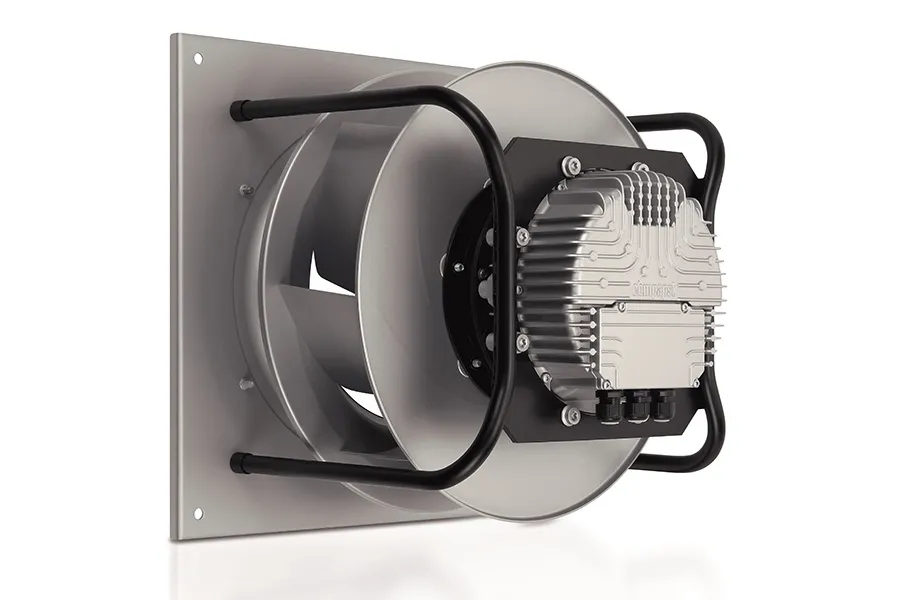
The air velocity in the unit is low to keep the fans’ electricity consumption to a minimum. This is achieved in part through the larger casing cross-section. “A more compact unit would have generated higher air velocities,” says Tom Melching. “Although it would certainly still have met the ErP Directive specifications, this would have had a negative effect on all the other components in the unit: pressure losses across individual air handling functions, such as the heat exchanger, filter and HRU system, increase at higher air velocities, resulting in higher electricity consumption by
the fans.”
Rotary heat exchanger
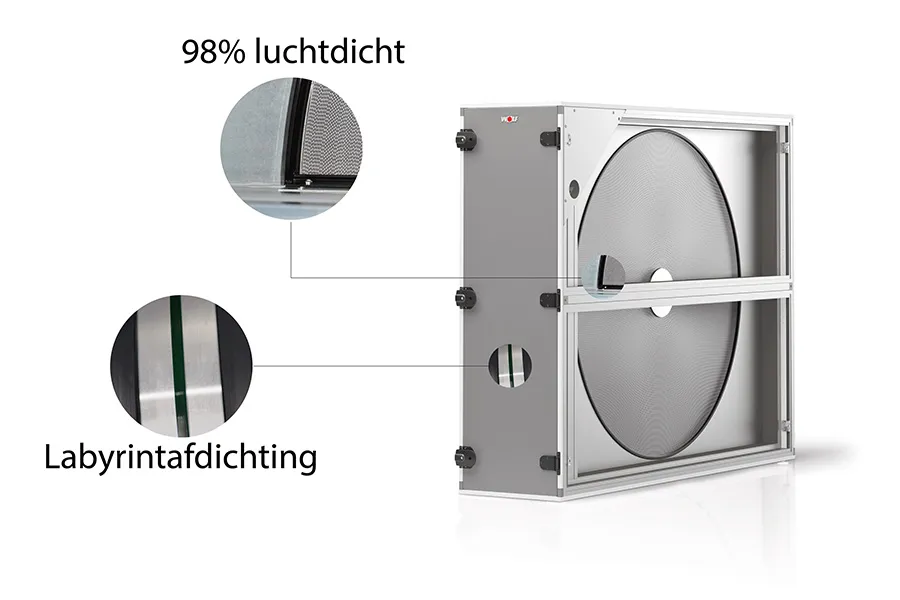
A highly efficient rotary heat exchanger with low leakage was selected for heat recovery. Tom Melching explains: “The sealing system is not positioned at the side of the rotor, but rotates with it. Several sealing fins on the wall ensure a high degree of tightness with the rotating part. Combined with central seals using the WOLF SuperSeal labyrinth seal, this makes it possible to achieve a tightness of 98%, unlike conventional models, which have a leakage rate of around 10%. In this case, additional air volumes must be factored into the fan design for supply and extract air in accordance with VDI 3803/5. This increases the fans’ energy consumption.”
High heat recovery
The unit’s heat recovery capacity is 116 kW (ErP: 108.6 kW), and its heat recovery index is 78% (ErP: 73%). “This results in a saving of 7.9%, or 8.2 kW, compared with the ErP value,” says Tom Melching. “With 5,000 operating hours a year, the WOLF unit saves 41,000 kWh of thermal energy through heat recovery alone. In terms of heating oil consumption, this is equivalent to saving around 4,180 litres of heating oil, or around 11 tonnes of CO2 equivalent. Based on a purchase price of 0.8 euros per litre of heating oil, this amounts to annual savings of 3,344 euros. Without increases in CO2 prices or other price rises, this equates to total savings of at least 66,880 euros over twenty years.”
Electricity consumption also compares favourably, according to the technical adviser. “Instead of the 950 W/(m³/s) stipulated by the ErP, only 561 W/(m³/s) per year is required here. That is just 59% of the reference value. The saving is 389 W/(m³/s), or 2.38 kW. Extrapolated over one year, that totals 11,900 kWh for 5,000 operating hours. Based on an electricity price of 0.4 euros, the saving amounts to 4,760 euros, or 5.18 tonnes of CO2 equivalent. That is equivalent to the average electricity consumption of three four-person households. Over twenty years, without inflation adjustment or CO2 pricing, this amounts to at least 95,200 euros.”
When the annual running cost savings are added together, the technically optimised WOLF unit delivers a remarkable total savings potential of 162,000 euros or 323.60 tonnes of CO2 equivalent. The break-even point for the additional investment in the more efficient unit is therefore reached after around one year, or sooner if the number of operating hours per year is higher or energy prices rise. The calculation above does not include the positive effect of intelligent control. In practice, consumption can be reduced further through demand-controlled operation based on room occupancy.
A business enquiry for WOLF Energiesystemen? Get in touch
Companies in this story
Keep following this
Get an email when a new story is published. No account needed.
- ThemeHealthy air and summer comfort
- SubjectVentilation
- CompanyWOLF Energiesystemen