Smarter control of heating and cooling with balancing valves
Text Philippe SelkeImage Aalberts hydronic flow control
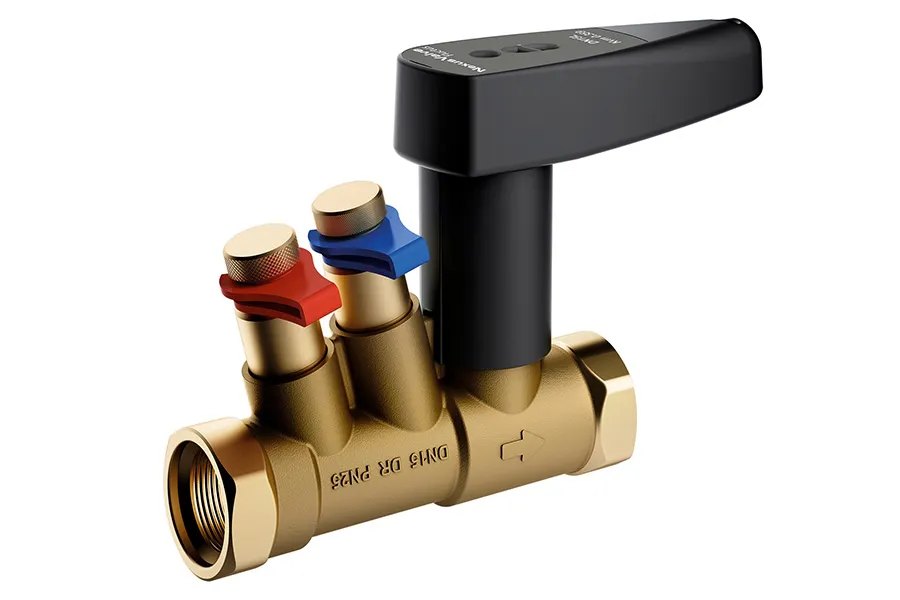
Under the Comap and NexusValve brand names, Aalberts hydronic flow control develops technologies that make heating and cooling systems in buildings easier to control and more energy-efficient, benefiting both end users and HVAC installers. Balancing valves are one example, ensuring an even distribution of water throughout the system. In this article, we take a closer look at the NexusValve balancing valves: the static NexusValve Fluctus and the dynamic NexusValve Vivax G2 EQM.
Bruno Bille, product line sales manager at Aalberts hydronic flow control, knows better than anyone how important it is to balance an HVAC system. He delivers training on the subject throughout Europe. “If water is not distributed properly around an installation, pressure is lost,” he says. “As a result, the system consumes more energy and CO2 emissions rise.”
“Balancing valves are standard in heating and cooling systems in larger buildings such as hospitals, care homes, schools and hotels. Static valves are fitted at the start of the circuit, on the manifold, to provide a stable baseline distribution. At the other end, by the radiators or fan coil units, dynamic valves ensure that the right amount of heating or cooling reaches them.”
Under the NexusValve brand name, Aalberts hydronic flow control markets both a static and a dynamic balancing valve: the Fluctus and the Vivax G2 EQM.
Time savings
“The NexusValve Fluctus is a static balancing valve that also serves as a shut-off valve,” says Bruno Bille. “It can be used in cooling, heating or domestic water circuits. Flow is measured using a built-in Venturi tube, which creates a controlled pressure difference, together with a fixed Kv value and a flow meter. This means you can measure to within 3%, saving time. Setting the flow rate is child’s play thanks to real-time visual feedback. What’s more, an integrated needle valve seals the valve perfectly, preventing leaks and wear.”
Bruno Bille also points to some of the NexusValve Fluctus’s special features. “Reliable measurements require a minimum distance from the pump, but that distance is considerably shorter with the NexusValve Fluctus. This is useful for renovations or in confined spaces.”
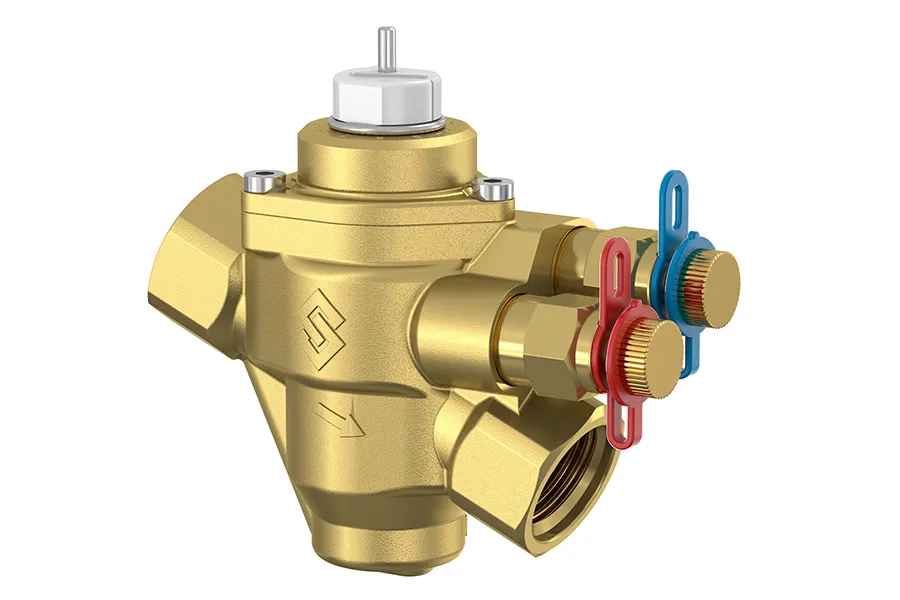
“The NexusValve Vivax G2 EQM is a dynamic balancing valve with an integrated control function. It maintains a constant flow rate, even when conditions in the system change. Thanks to its so-called equal-percentage control characteristic, the valve responds sensitively: small movements produce only a small change in flow, while larger movements produce progressively greater changes. This allows very precise control,” explains Bruno Bille.
“In our temperate climate, full heating capacity is needed for only a few days a year. That is why the NexusValve Vivax G2 uses a modulating motor that continuously adjusts the flow rate to match actual demand. This prevents constant switching on and off, improves thermal comfort and increases efficiency.”
Another interesting feature of the Vivax G2 is that, while other valves have a stroke length of 2.5 to 4 mm, this valve reaches 6 mm, and remains active over 3 mm even at low flow rates. Bruno Bille says: “This reduces the risk of blockage. And by preventing excessive flow, the valve keeps the water return temperature low, reducing the load on the pump and increasing the efficiency of condensing boilers.”
Built-in test points
Both the NexusValve Fluctus and the NexusValve Vivax G2 EQM come with built-in test points as standard. These also make the installer’s job easier, both during commissioning and maintenance. “This is no small matter,” concludes Bruno Bille, “because nothing tells you more about how an installation is really working than balancing valves. Strategically placed test points, based on the hydraulic diagram, help you locate faults more quickly and resolve them in a targeted way. In short, these valves show you what other components cannot.”
In short, the NexusValve Fluctus and Vivax G2 EQM make it easy to balance any HVAC system, delivering constant flow rates, better control, maximum efficiency and optimum comfort.
Question about this story? Ask your question
Keep following this
Get an email when a new story is published. No account needed.
- SubjectHeat pumps