From smart homes to smart cities
Text Ingrid Allaerts Beeld iStock & Pixabay
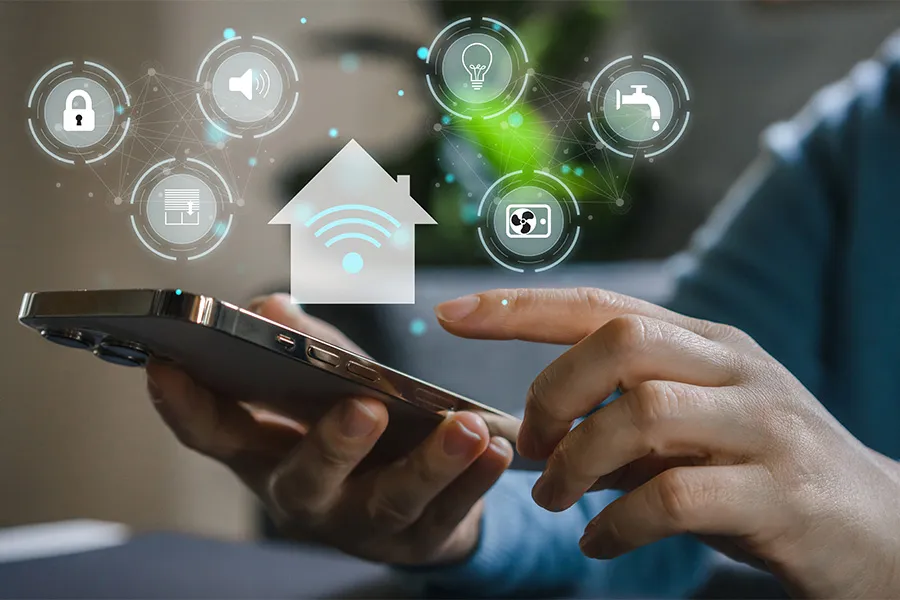
A smart home is a house where electronic devices and systems communicate with one another and perform tasks automatically. The concept is evolving at a rapid pace. What are the latest trends and innovations for bringing smart comfort to homes? And why will we evolve from smart homes to smart cities?
In a smart home, lighting, heating and humidity are controlled intelligently and simply using sustainable, energy-efficient solutions, creating a healthy indoor climate.
Efficient heating systems
A smart home is equipped with intelligent radiator thermostats. Flexible control options and demand-based consumption can save you a great deal on heating costs. An app intelligently and automatically distributes the solar energy generated on site. This can also help you save on electricity costs. In a smart home By 2050, Europe aims to be climate-neutral and emit as few greenhouse gases as possible. Investing in heat pumps is a smart investment in green, future-proof living. Heat pumps are not just suitable for new-build homes. There is also a suitable heat pump for every application in existing homes. By drawing on heat from the surroundings, a heat pump makes you independent of fossil fuels. When you combine a heat pump with solar panels, you do not have to draw all your electricity from the grid. This allows you to make the most of the electricity you generate yourself. A home battery also enables you to maximise your use of self-generated electricity. Smart homes also incorporate energy management systems to optimise energy consumption.
Smart ventilation for every room
Healthy indoor air is essential for comfortable living. There are already many ventilation systems on the market. But what if your home is fully finished and a central ventilation system is not practical? A local ventilation unit with humidity, VOC and optional CO2 monitoring could provide the solution. It delivers full ventilation without major renovation work. And keeps the toilet smelling fresh.
For those looking for a central ventilation system as part of a major renovation, there are systems that switch on automatically when sensors detect excessive humidity, odours or CO2 in the indoor air. They ventilate only where and when needed, and in the right quantity, preventing unnecessary energy consumption. These systems supply fresh air naturally through window vents, while controlled mechanical extraction removes polluted air.
This means you can ensure healthy, fresh indoor air in any situation, whether you choose a local or central ventilation solution.
Advanced security
A smart home is also a safe home for its residents. The challenges around security have grown considerably in recent years. A smart alarm system with sensors and cameras that record everything provides optimal protection against burglars, fire hazards and the threat of water damage. The alarm system is highly effective because all the devices are connected and communicate with one another and with the outside world. In a smart home, all devices communicate with one another with a single aim: to increase comfort and safety and make everything as simple as possible. This is made possible by, among other things, easy installation (wirelessly or on the existing network), ease of use (everything in one app) and intelligent options for expansion.
Intelligent home automation
Sensors are the eyes and ears of the intelligent home automation system. They continuously collect data and send it to the central controller, enabling the home to respond proactively to different situations.
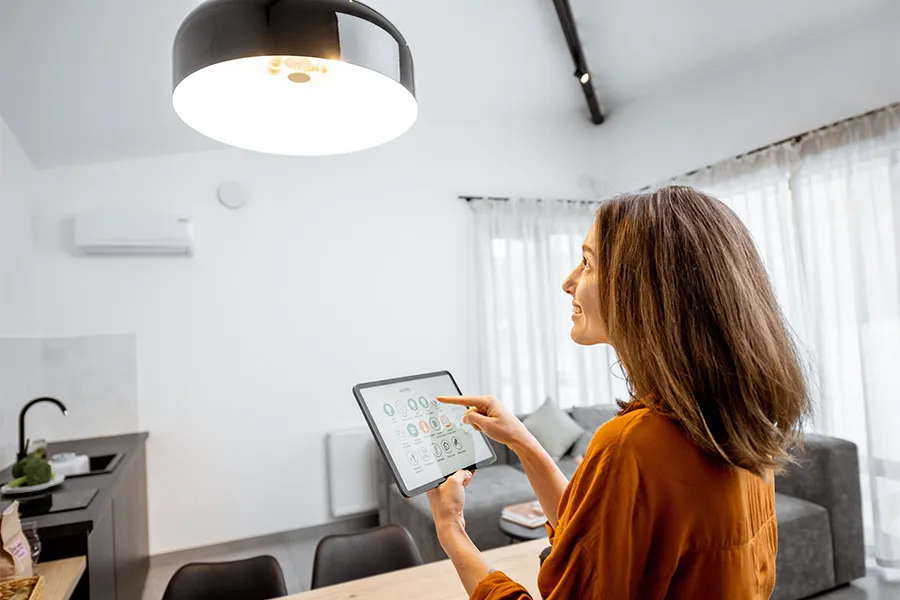
For example, when the temperature drops, the heating switches on, or when movement is detected, the lights come on. From thermostats to lighting and security cameras, smart devices add comfort and efficiency. The temperature in a room can be adjusted automatically for optimum comfort. The lights dim depending on the time of day. Live camera footage is streamed to your smartphone. These accessible systems make any home smart. Smart automation systems make it possible to use energy more efficiently. It is important to gain insight into your energy consumption and your home's energy production, as well as that of all your individual appliances. By intelligently managing your energy flows and automatically spreading your consumption, you can avoid peaks in energy use.
Connected sockets or smart plugs switch on automatically when you have surplus solar energy. This means you always make the most of the energy you generate yourself. You can automate switching lights on and off with a motion sensor, saving up to 30 per cent on energy. A personalised all-off function is handy too.

Smart cities
By 2030, people around the world will live in cities. Cities are growing and innovating at a rapid pace. They are becoming low-emission zones, and green architecture is springing up. Smart homes are becoming smart cities. Local authorities want to redesign their neighbourhoods to make them more resilient and environmentally friendly. They are doing so by making their energy policies more sustainable, developing energy communities for renewable energy and storing shared energy together. In the future, these technologies will be seamlessly integrated into our daily lives. They will optimise traffic flows and reduce energy consumption. More and more renewable energy will be systematically integrated into buildings. Transport is being electrified rapidly, and this trend is gathering pace. The Internet of Things is an ingenious network that connects everything and collects and exchanges data. By analysing and sharing data, companies can improve their production processes, reduce maintenance costs and personalise customer service. All this contributes to a better quality of life by improving health, safety and comfort in everyday life.
Question about this story? Ask your question
Keep following this
Get an email when a new story is published. No account needed.
- SubjectElektroTech