System water in HVAC installations: causes of problems and solutions for better performance
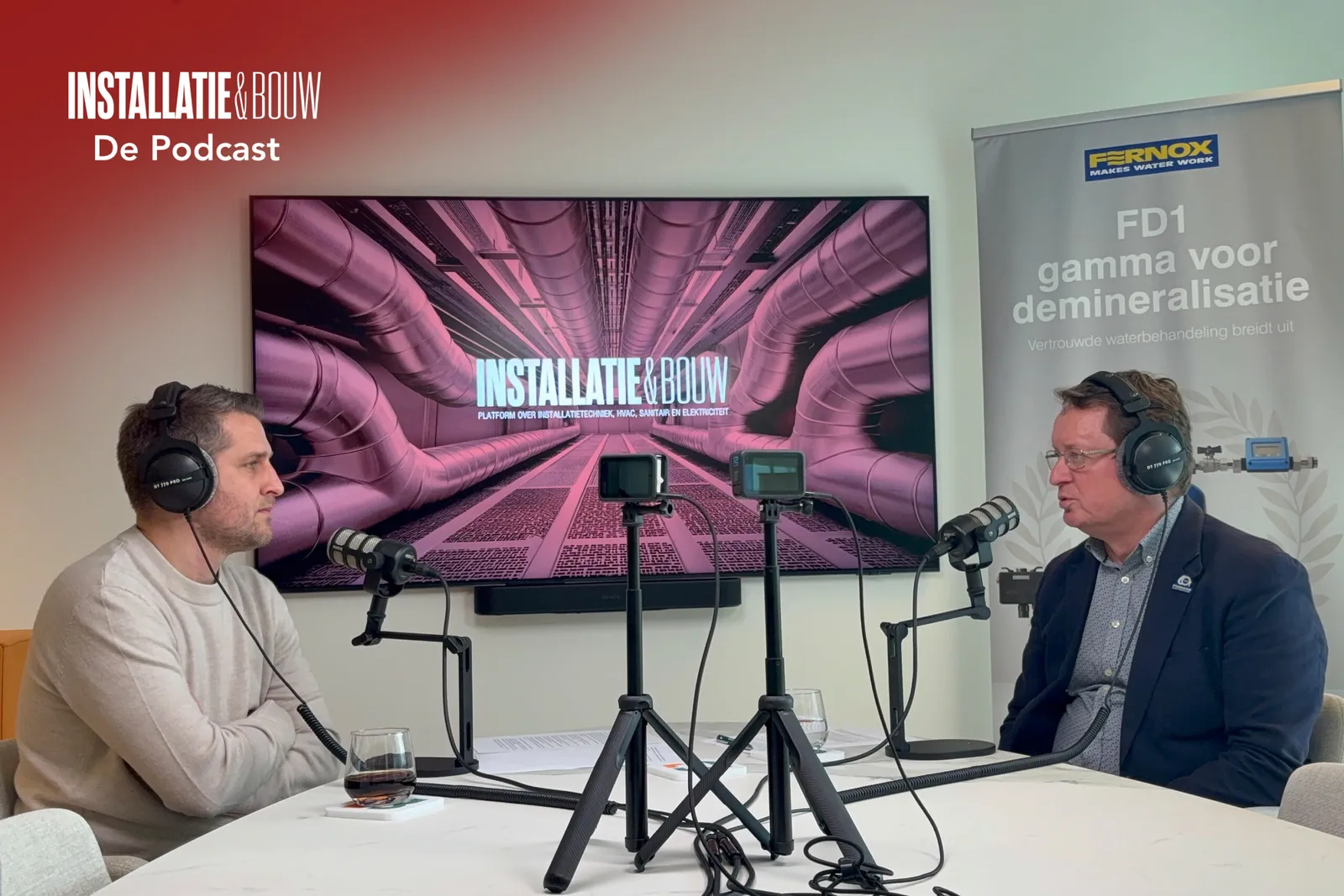
In conversation with Yves Desplenter, hosted by Wouter Polspoel
System water plays a crucial role in the performance and service life of HVAC installations, but in practice it often receives too little attention. In this episode of the Installatie en Bouw podcast, Wouter Polspoel talks to Yves Desplenter (Fernox) about the impact of water quality on heating and cooling systems. From sludge formation and corrosion to heat pump faults: find out why problems are often addressed too late and what preventive measures installers can take to structurally improve efficiency, reliability and service life.
Een zakelijke vraag aan Fernox? Get in touch
Full transcript
All chapters (21)
- Introduction and the importance of system water
- Introducing Fernox
- Why water quality is underestimated
- The myth surrounding black water
- Causes of problems in HVAC installations
- A combination of factors
- Heat pump sensitivity
- Why sensitivity is higher
- Component sensitivity
- The role of water quality in faults
- Risks when renovating
- Preventive measures
- Monitoring and maintenance
- Responsibility for maintenance
- Water quality and warranty conditions
- Consequences of faults
- Practical solutions in the sector
- A change in mindset in the sector
- Expectations for the future
- Recommendation for the sector
- Closing
Introduction and the importance of system water
Wouter Polspoel Welcome to a new episode of the Installatie en Bouw podcast. Water is found in every heating and cooling system, but it rarely gets the attention it deserves. Yet this seemingly mundane system water often determines the performance, service life and reliability of the installation. Today, I’m discussing this with Yves Desplenter from Fernox. What exactly goes wrong in practice? Why is the issue still underestimated? And, above all, how can it be tackled systematically? Hello, Yves.
Yves Desplenter Hello, Wouter.
Wouter Polspoel First of all, Yves, could you briefly introduce Fernox?
Introducing Fernox
Yves Desplenter Fernox is a British company specialising in water treatment for heating, cooling, solar panels and heat pumps. We do this both chemically and using other methods, such as a magnetic filter.
Why water quality is underestimated
Wouter Polspoel Yes, thank you. Yves, you’ve just taken part in a round-table discussion we recorded on this topic. The coverage appears in the second issue of Installatie en Bouw this year. One thing that stood out in the discussion was that the quality of system water in heating and cooling systems often only gets attention once problems arise. Why do you think system water quality remains such an underestimated issue?
Yves Desplenter Very often, installers only intervene when problems actually occur. The sector knows, though, that untreated central heating water frequently causes problems and that preventive action is needed. Fortunately, with more guidance from both boiler and heat pump manufacturers, as well as specific support from the sector, we’re seeing installers take more and more steps in the right direction.
Read the full transcriptCollapse transcript18 more chapters
The myth surrounding black water
Wouter Polspoel All right. Was there a particular comment or observation from the round-table discussion that stayed with you?
Yves Desplenter The persistent myth in our sector is that black water is dead water and therefore good water. I’m glad we’re taking a clear step forward together with heat pump manufacturers. Contamination has no place in a central heating system, and certainly not in a heat pump system. Dirty water can never be good water, whether it’s black or not.
Causes of problems in HVAC installations
Wouter Polspoel Clear. If you had to identify the technical mechanism most often behind problems in HVAC installations, what would it be? Magnetite formation,
Yves Desplenter oxygen ingress, limescale, sludge? Very often, these phenomena go hand in hand. It often starts with a slight build-up of limescale. People try to deal with that by flushing the system. Then they refill it with fresh water. Fresh water brings in air and oxygen, which leads to corrosion, which in turn leads to sludge formation. So one effect compounds another if you go down the wrong path. It’s rarely just one of the phenomena I mentioned that causes the problem. Usually, several factors combine.
A combination of factors
Wouter Polspoel And what exactly happens in a system when magnetite, sludge or one of the other problems we’ve mentioned develops? Where in the system does it usually go wrong?
Yves Desplenter There are several crucial components in a central heating system. Very often, the pump starts to perform less effectively when circulating the water, control devices and three-way valves seize up, pressure sensors produce error messages, and eventually the boiler faults or the heat pump has insufficient flow. So, here too, you can see that several components are particularly susceptible to contamination and limescale particles.
Heat pump sensitivity
Wouter Polspoel You’ve mentioned heat pumps and boilers, but if I understand correctly, heat pumps and other low-temperature systems are more sensitive to poor water quality than conventional boiler systems. Is that right?
Yves Desplenter That’s right.
Why sensitivity is higher
Wouter Polspoel And why is that exactly?
Yves Desplenter Heat pumps are less able to remove air from a system than, for example, a conventional wall-mounted gas boiler fitted with a microbubble air separator. In practice, that means a domestic heat pump system can often contain a great deal of air, and therefore oxygen, making it highly susceptible to corrosion.
Wouter Polspoel So that’s because of the lower temperature?
Yves Desplenter Lower temperatures are one factor, but another is the extensive use of underfloor heating, which means there is a large proportion of plastic pipework. There are usually still some metal components in the system, though. These are then exposed to oxygen, resulting in a lot of localised corrosion.
Component sensitivity
Wouter Polspoel Yes, and is it also true that pipes in low-temperature systems are narrower than in conventional central heating systems, or is that not quite right? And does that make them more susceptible to problems? Not so much
Yves Desplenter the pipes, but the heat exchanger in a heat pump. It has very small, specific channels, which are indeed highly sensitive to even slight contamination. Heat pumps often also have a built-in strainer, which can become clogged very quickly, reducing circulation and the heat pump’s energy efficiency.
The role of water quality in faults
Wouter Polspoel Yes, right. When Fernox analyses poorly performing installations, how often does water quality turn out to be the cause or a significant contributing factor?
Yves Desplenter We’re very often called out when problems have already arisen. In that sense, we’re often there when things go wrong. In 9 out of 10 cases, water quality turns out to be part of the problem. Of course, if there are fundamental design faults in a system, water quality alone won’t solve them. But the reverse is also true: even if a system is well installed and designed, water quality always affects its overall operation.
Risks when renovating
Wouter Polspoel During renovations, heat pumps are often connected to existing circuits. Does that pose specific risks to system water quality?
Yves Desplenter Absolutely. In renovation projects where part of the system is retained, whether the radiators or the pipework, to avoid the cost of replacing the entire system, you’ll find that a system that is fifteen years old or more almost always has some degree of contamination. It’s therefore essential to assess these systems beforehand, estimate how much contamination may be present and decide on the best way to clean and flush the system.
Preventive measures
Wouter Polspoel Yves, what do you think are the three most important measures installers can take when installing a heating or cooling system
Yves Desplenter to prevent problems with system water? With a new installation, you have the ideal opportunity. The water is clean, so take every possible precaution to keep it that way. I’m thinking of demineralising the water and protecting it with F1 protector, a corrosion inhibitor. If it’s an existing system with contamination, the first step is to clean the system. You should also fit magnetic filters on the return pipe to remove as much contamination as possible from the central heating system.
Monitoring and maintenance
Wouter Polspoel Yes, all right. How do you monitor system water quality over the service life of an installation, and does this happen in practice?
Yves Desplenter Systems are still subject to maintenance, and under technical specification 278, water quality should also be checked during central heating system maintenance. Unfortunately, many people treat this specification as a dead letter. We see that not all installers monitor the system in this way. Magnetic filters are sometimes not cleaned. Yet maintenance is the ideal time to check the water quality circulating in a system that has been in service for some time.
Responsibility for maintenance
Wouter Polspoel But is it the installer’s responsibility to carry this out periodically, or is it actually up to the end user
Yves Desplenter to raise the alarm? There is a legal requirement for a wall-mounted gas boiler to be serviced every two years, so the responsibility for arranging this lies with the end user. However, when carrying out maintenance, the installer is responsible for inspecting the entire system and assessing what else needs to be done, including cleaning any magnetic filter that is fitted.
Water quality and warranty conditions
Wouter Polspoel To what extent does water quality affect warranty conditions? Do manufacturers set specific requirements for
Yves Desplenter system water? Absolutely. If you look at the installation instructions from any manufacturer, you’ll usually find requirements for the hardness, conductivity and pH of the fill water, which must be met before it is added to the central heating system.
Consequences of faults
Wouter Polspoel Yes, all right. And in that case, I understand that the warranty always applies. If a system fails because of poor system water, what happens in practice? Will the manufacturer simply replace the entire system, meaning the heat pump?
Yves Desplenter Usually, the first step is to identify the exact problem. If there is contamination and a component needs replacing, the installer and heat pump manufacturer will often discuss the costs and who is ultimately responsible. As well as being a technical issue, it is also a purely economic one, and the installer and manufacturer often find a solution between them.
Practical solutions in the sector
Wouter Polspoel Yes, that was also discussed in the round-table conversation. Replacing the entire installation is very expensive, and of course users cannot do without it. So the problem is often resolved quickly, without the need for a full replacement or even taking the manufacturer to court.
Yves Desplenter Legal proceedings are always lengthy. For that reason, the sector generally tries to avoid them and looks for a possible solution between the parties.
A change in mindset in the sector
Wouter Polspoel You may have touched on this briefly earlier, but are you seeing a change in mindset among installers and engineering consultancies regarding system water quality in heating and cooling systems?
Yves Desplenter There are two sides to it. Let’s start with the positive. There are indeed a number of people, both engineering consultants and installers, who are seeking guidance and asking heat pump manufacturers: what exactly has changed between a conventional gas-fired wall-mounted boiler and a heat pump? What has changed in terms of technology? What do we need to do differently? How can we guide this process? That gives me reason to be hopeful. There are also players in the market who still try to apply the simple formula of taking one boiler off the wall and putting another in its place to heat pumps. Just remove the old boiler, install the heat pump and, hey presto, everything is done. My hope is that the first group will become large and strong enough to steer the energy transition in the right direction.
Expectations for the future
Wouter Polspoel Is that purely a hope, or do you also expect it to happen?
Yves Desplenter I expect it to happen, and we are working towards that with many players in the sector. We are doing so, among other things, by continually highlighting water quality, explaining its importance, offering the opportunity to take training courses and request information, and simply applying the right techniques.
Recommendation for the sector
Wouter Polspoel Right, okay, one last question, Yves. If you could make one recommendation to the installation sector to improve system water quality in heating and cooling systems, what would it be?
Yves Desplenter Seek guidance from qualified professionals. Ask your heat pump manufacturer about training. Ask why water quality matters and what benefits it brings to the overall design of a heating system. If you have questions, ask them.
Closing
Wouter Polspoel And just to be clear, that advice is for installers, not end users.
Yves Desplenter Installers are the ones who need to have the knowledge to deliver this energy transition
Wouter Polspoel in the right way. Right, that’s a good conclusion. Thank you, Yves. I should also mention that you took part in the round-table conversation on this subject, which is covered in Installatie en Bouw 2 this year. That issue is due to appear in the second half of April.
Yves Desplenter Thank you, Wouter.
Companies in this story
Keep following this
Get an email when a new story is published. No account needed.
- ThemeImproving building services performance
- Subject2026
- CompanyFernox